In any sophisticated materials science and laboratory research, it is no less important than controlling the experimental environment being able to control the materials under study. Regardless of whether they are studying semiconductor materials, optical materials or new crystal structures, scholars have to have hermetically laboratory tube sealer conditions to avoid contamination, oxidation or other unreliable chemical reactions. A flame sealing is required here.
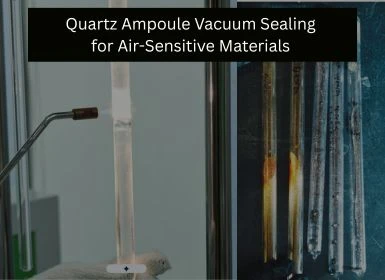
Quartz ampoule sealing is popular in laboratory crystal growth experiments, particularly in experiments in vacuum or controlled atmosphere. Quartz has been used in the study to permit scientists to formulate an isolated setting where possibilities of controlling temperature and pressure can be executed. Due to its high quartz glass melting point, it is suitable for packaging items that must withstand long firing and heat processing.
Through learning the art of flame sealing, labs can strive to make sure that delicate experiments occur without interference by the atmospheres, which greatly enhance the reproducibility and data accuracy.
Quartz is an experimental materials science foundational material. In certain common crystal growth science projects, ampoules or tubes of quartz are used to hold raw materials in the generation of high-temperature synthesis. The purity of the material would also mean that only a minimum amount of contamination would occur and its transparency would enable it to be monitored visually during heating cycles.
In a quartz scientific glass sealing experiment of crystal growth, proper integrity of the container would directly relate to the quality of final crystal. Quartz has exceptional thermal shock resistance and chemical corrosion and hence is best in processes that require reactive gases or vacuum environment.
High quartz glass melting point is one of its characteristic features, ranging to 1,650-1,700degrees C of fused quartz. This high melting temperature allows quartz to withstand the high temperatures needed to grow crystals like oxides, halides and semiconductors. The low thermal expansion coefficient is also minimizing stress cracking in cases of rapid changes in temperature.
These characteristics not only cause quartz to be an object of container, but also an important element of experimentation design in extreme crystal growth science experiment studies.
One of the most frequent questions asked by researchers starting the work with laboratory synthesis is: would it be possible to seal quartz tubes with each experiment? It is dependent on the environment of the reactions and the sensitivity of materials used.
If the experiment requires:
Then sealing must take place.
The other one that is commonly heard is do you have to seal quartz even when doing short heat cycles. In a great deal of crystal growth, the slightest exposure to air may change stoichiometry or add impurities. In moisture sensitive material or high purity semiconductor material then sealing is used to guarantee stability of the material during the thermal process.
Ampoules of sealed quartz would be of particular importance when using reactive metals, systems based on sulfurs, or halogen-based systems. In such instances, keeping a closed system ensures that the system is not contaminated in addition to safeguarding lab operators against the dangerous vapors.
Flame sealing: This is a manufactured heating performance applied to welding quartz tubing in a hermetic shut. As opposed to mechanical caps or the adhesive processes, flame sealing is a permanent bond between glass and glass that prevents any vacuum leakage at high temperatures.
The question that researchers pose is how to seal quartz such that it is not prone to stress fractures or the development of weak joints. The trick here is in the heating up of the material and handling it with caution even when it is soft. Due to the extreme heat necessary to effect a fusion, a lot of material on how to melt quartz glass in a safe and even manner is important.
Flame sealing is associated with a number of benefits:
In comparison to other sealing methods, flame sealing produces a monolithic structure, which is useful in growing crystals in ampoule form that have to withstand harsh furnace operating conditions.
Special equipment is needed to have accurate quartz seals. A flame welding torch used on quartz work has a highly focused, high-temperature flame, and can be used to heat fused silica to softening temperature.
In laboratory settings, a flame sealing torch is normally hydrogen-oxygen or high-temperature powered. The nature of these torches is that they offer the clean combustion that is required to prevent the risk of contaminated quartz surface.
A commonly known instrument in a laboratory is the chemglass flame sealing torch, which is said to provide controllable and continuous heat. These torches enable the technicians to carefully spin the quartz tube during the heating process so that the softening can be even and the closure is smooth.
Appropriate choice of the torch has direct impacts on the quality of seals, repeatability, and safety of the operators.
Learning how to seal quartz should take technical accuracy and the safety measures. This is a basic outline of the procedure undertaken in the laboratory setting, these are arranged in a sequence:
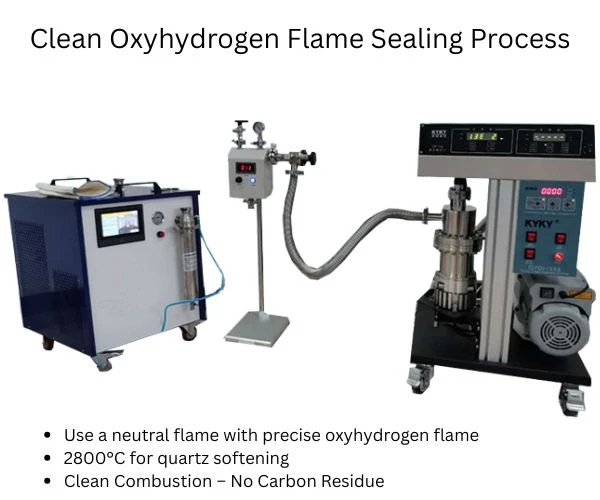
This is a process that is commonly referred to as quartz sealing and it requires a lot of patience and expertise. Quick heating and uneven distribution of flame will lead to feeble seals or structural problems.
The safety factors are:
Cooling must be done very accurately and with precision to avoid stress fractures.
The researchers are required to bond borosilicate glass sealing elements with quartz in certain experimental systems. These materials have varying thermal expansion coefficients and thus direct sealing cannot be done without intermediary layers.
Graded seal transition: There is a quartz-to-borosilicate graded seal that allows a smooth transition between materials, thus reducing the stress. When sealing borosilicate glasses, special attention is paid to the temperature control so that each material would soften at the right moment without cracking.
In vacuum manifolds or those systems that use a combination of borosilicate connectors and quartz reaction chambers, graded seals are necessary.
There are no fissures in the sealing onto the brick below. In actual applications of fused silica components, a fused silica glass tube seal would necessitate higher temperatures than in normal glass. Even though fused silica has been termed as quartz, it is a slightly different manufacturing process.
Fused silica is even more purer and more thermally stable, and is suitable in experiments of ultra-high purity. Nevertheless, to achieve a seal, the flame control must be very concentrated and slow cooling must be made to eliminate microfractures.
Knowledge of these material differences gives compatibility and long-lasting stability of laboratory systems.
Advanced sealing systems are also quite beneficial to laboratories that are interested in a higher level of repeatability and precision. Laboratory Scientific Glass Vacuum Sealing system combines controlled gas movement and precision heating processes in order to improve the laboratory quartz tube sealing machine activities.
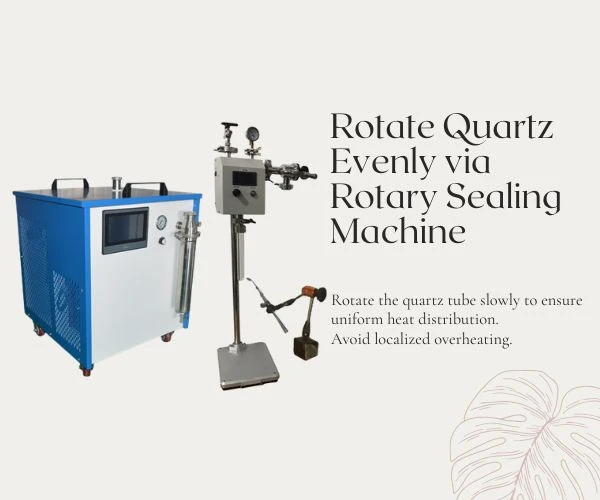
This system is intended to be used in research facilities that are carrying out complex synthesis or how to seal quartz experiment procedures. This simplifies the process of sealing quartz with all samples. It generates control over fluctuation and reliance on the operator through the introduction of flame control and vacuum management.
These are systems that are especially useful in institutions that have to work with large numbers of experimental ampoules or are in need of the rigid quality control requirements.
The challenges experienced during the sealing of quartz by even experienced technicians arise. Problems can be caused in a standard crystal growth science experiment because of incompetent heating profiles or a polluted environment.
Common problems include:
The presence of bubbles in the seal- It is usually due to the presence of trapped air or heating imbalance around the quartz glass melting point.
Incomplete fusion – Finish Products of inadequate temperature or patchy application of flame.
Stress cracks upon cooling -It is brought about by the rapidity of temperature shift or incorrect rotation during heating.
Surface devitrification – This happens when overheating is continued beyond reason.
To seal well with scientific glass quartz, it is essential to have a constant movement of the flame and controlled cooling. Variability is also minimized by inspecting gas supply systems and aligning the torch on a regular basis.
The creation of a standardized sealing protocol in the laboratory is very beneficial in sustaining reliability over a long period.
Environmental control plays a role in the success of an experiment in laboratory crystal growth research. A correct division of the quartz ampoule in its sealed format is expected to guarantee that sensitive reactions occur without contamination, oxidation, and gas exchange.
With the skills of using a flame sealing torch, a type of hermetically sealed system that can withstand high temperatures in the furnace, and long heating processes can be developed by researchers. Knowledge of material properties, especially thermal behavior and melting properties, can be used to make safer and more predictable results.
In the small academic labs up to highly industrial research centers, flame sealing is still an essential method in crystal synthesis. With the development of materials science, the use of precision quartz sealing will persist in obtaining reproducible and high-quality experimental data.