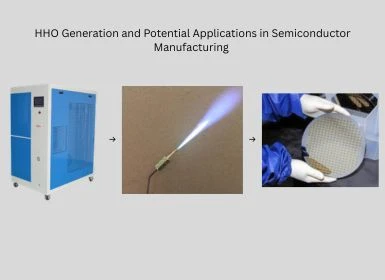
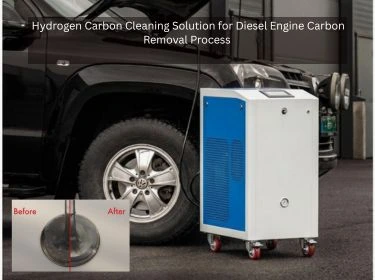
The worldwide trend towards cleaner energy and lower carbon emission has enhanced the implementation of new technologies within the industries. Of them, Hydrogen has proven to be an effective substitute form of energy that can transform the manufacturing industry, and the energy industry. Governments, industries and research institutions are progressively pouring investments into the use of hydrogen based solutions so as to achieve sustainability objectives.
The hydrogen generator technology is at the centre of this change because it facilitates the generation of hydrogen at any time without the use of conventional sources of fossil fuels. The major hydrogen technologies companies are being innovative in this area and they have advanced systems that are used in the industrial, commercial and laboratory systems.
The recent hydrogen technology news today indicates a fast growing number of hydrogen infrastructure, pilot-projects, and massive application of hydrogen in industries. Energy production to heavy manufacturing, hydrogen generators are now becoming one of the pillars in the entire process of transition towards cleaner and more efficient operations in the world.
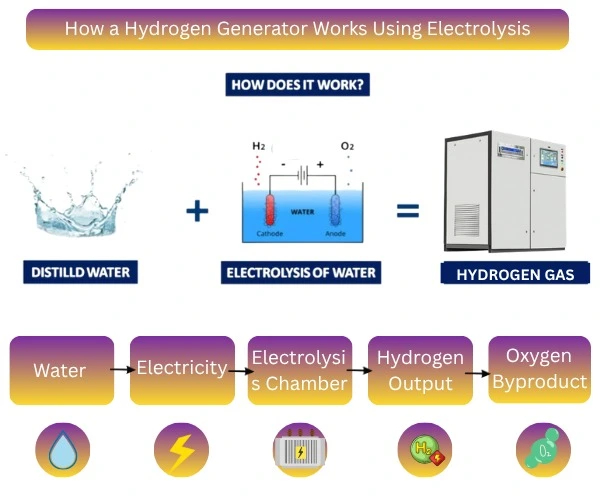
Learning how does a hydrogen generator work is a way of understanding its contribution to the contemporary industry. In essence, hydrogen production depends on the electrolysis process, a process that involves the use of electricity to destroy the water molecules into hydrogen and oxygen gas.
This is referred to as water electrolysis technology, and it is the process of utilizing an electric current on water, normally augmented with an electrolyte to separate hydrogen on the cathode and oxygen on the anode. This leads to the formation of an environmentally clean and efficient way of making hydrogen that is not harmful.
Hydrogen gas generator from water are implemented to make the system optimize this process so that the rate of gas productions and efficiency is high. Since industries seek alternatives in their hunt to achieve products that are less polluting, how to generate hydrogen sustainably has become a serious area of interest.
Studies on websites such as the Science Direct and the journals like the Nature have shown the ongoing efficiency in the processes of electrolysis that have made the production of hydrogen cheaper and applicable to large scale applications.
The emergence of the green hydrogen technology in the past few years is one of the most substantial developments that generate hydrogen using renewable energy resources like solar and wind. In contrast to traditional hydrogen production processes, green hydrogen produces no carbon emissions, and thus, it is a major constituent in the decarbonization plans of the world.
Hydrogen technology applications in energy storage and grid stabilization The addition of hydrogen systems to renewable energy grids has added additional applications of hydrogen technology. Unutilized solar or wind energy may be utilized to energy systems involved in electrolysis thus getting a hydrogen that may be utilized later as fuel.
Such innovations as the solar hydrogen generator show that clean energy and the production of hydrogen can go hand in hand. The scalability of such systems according to research by the International Energy Agency (IEA), as well as the major universities, has shown that such systems have the potential to cut down industrial carbon footprints by a significant amount.
With the industries looking at sustainable alternatives, the green hydrogen is coming out as an answer to fossil fuels replacement in the processes that are energy intensive.
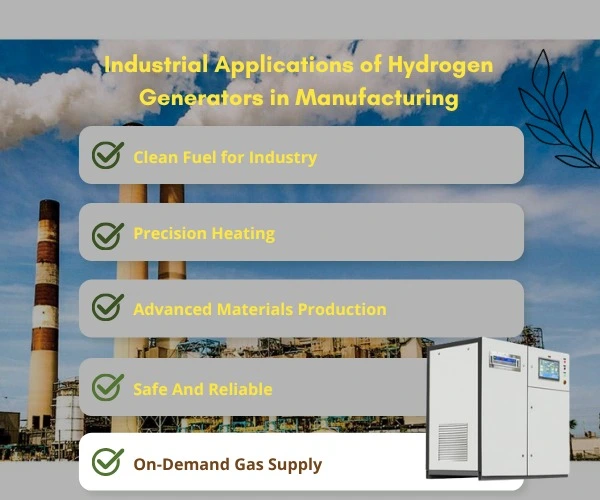
Hydrogen generators are making a revolutionary impact in the modern manufacturing. With the help of an industrial hydrogen generator, industries like steel production and chemical processing and fabrication endeavors can switch to cleaner and more efficient operations.
Replacement of fossil fuels with hydrogen can be taken as one of the most important hydrogen technology applications in terms of combustion and heating processes. It is not only a shift that lowers emissions but it also enhances efficiency and quality of the product that is being manufactured.
To take an example, hydrogen is also becoming utilized in superior production technology such as production of lab grew diamonds, where exact control of temperature is needed. In line with this, similar systems that have led to a revolution in industrial cutting and brazing works are hydrogen based flame systems, such as the Oxy Hydrogen Generator.
Organisations like Ptxson hydrogen are also playing their part in this transformation by coming up with advanced systems of hydrogen generators that are adapted to the industrial requirements. These inventions are assisting manufacturers to attain a cleaner production but with a high performance and reliability.
In addition to the heavy industry, hydrogen generators have other uses such as in the laboratory and precision environments. High-purity hydrogen is supplied by a laboratory hydrogen generator which is a dependable origin of high-purity hydrogen that is used in analysis tools and research.
Hydrogen is a commonly used carrier gas or component in reaction or analysis in the fields of gas chromatography, material science, and chemical analysis. Generation of hydrogen on command increases the safety, decreases the use of gas cylinders, and stabilizes the level of purity.
Universities and scientific institutions have contributed to the growth of hydrogen generator technology in research settings and this has resulted in the need to take controlled hydrogen production seriously. The new discoveries are essentially being made possible by these advancements, as well as making experiment results more precise.
As demand grows in all types of R&D agencies, hydrogen generators are becoming an essential instrument in contemporary labs, serving several hydrogen technology applications.
The development of hydrogen generation systems is still in progress due to continuous innovation. The study of water electrolysis technology has led to great efficiency, thus consuming less energy to produce hydrogen, and the process has become economical.
Academic human resource centers all over the world are coming up with the next generation electrolyzers that have increased performance and durability. Indicatively, the technology of Korea Institute of Energy Research is aimed at enhancement of the hydrogen production capacity with a reduction of energy loss through enhanced electrode materials and systematic design of a system.
The most hydrogen technologies company are also putting efforts on hybrid systems, which will incorporate renewable energy sources with high-order electrolysis methods. These inventions are aiding to scale up production of hydrogen and make it more industrial-wide.
With the evolving hydrogen generator technology, it is becoming more efficient, affordable, and flexible, and this is the way forward as it becomes more viable to be implemented in both industrial and energy sector.
The future of hydrogen generators is extremely bright as the world still demands clean solutions of energy. The governments and the world of conservation are putting lots of funds in the hydrogen infrastructure such as production facilities, storage facilities, and distribution channels.
The green hydrogen technology growth will be plausible in attaining the net-zero emission levels. Hydrogen is not a fuel being employed only but also as a medium to store energy which allows a more efficient usage of renewable resources.
The new technology like the solar hydrogen generator emphasizes the possibility of decentralization of hydrogen generation, since the industries or even individual households can produce their own clean power. This decentralization may transform the energy systems and make them more sustainable and hardy.
Now that industries are beginning to find more applications of hydrogen generator technology will become a standard solution in industries. As the thydrogen technology applications is continually innovated and developed through international collaboration, the development will continue being ahead of the shift to the more sustainable and cleaner future.