The necessity to move towards sustainable energy in the world has greatly boosted production of clean hydrogen in various industries. In manufacturing as well as energy storage, hydrogen is emerging as the key material towards carbon-neutral ambitions. The key aspect of this change is the water electrolysis technology that allows the synthesis of hydrogen with the assistance of electricity and water without the use of fossil fuels.
Electrolysis is an essential way to facilitate the production of hydrogen needs on-demand, as industries will produce hydrogen when required and where they will be required. As the use of systems like Hydrogen Generator and Oxy Hydrogen Generator solutions continues to grow, efficiency, scalability, and environmental performance are becoming the priorities of businesses.
The type of electrolysis process should thoroughly be chosen, and yet, it will directly influence operation cost, system efficiency and long term sustainability. At this point, the comparison process between the PEM vs alkaline electrolysis is critical. This difference is important to make an informed hydrogen production system comparison especially when comparing more advanced alkaline water electrolysis technology with a more conservative and conventional one.
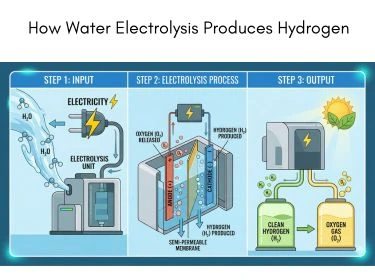
Fundamentally, the process of hydrogen production by electrolysis is the process of splitting up the water molecules (H2O) into hydrogen (H2) and oxygen (O2). The working principle of the modern water electrolysis technology is based on this process and is very common in industrial and laboratory applications.
A normal electrolysis system would be made up of electrodes (anode and cathode), an electrolyte, which helps in the movement of ions, and power supply. Electricity is introduced, whereupon Hydrogen gas is emitted at the cathode and Hydrogen oxygen generated at the anode.
The conceptualization of how to build hydrogen generator can be understood by optimizing the components in a way that achieves constant and effective production of hydrogen. The current systems are made using advanced materials and control systems in order to increase performance and life span.
Electrolyzer efficiency is one of the most important considerations in the system design as it shows how the electrical energy can be turned into hydrogen. As the pem water electrolysis technology develops, scientists and companies are continually increasing the level of efficiency, thus making hydrogen production to be more applicable on a large scale.
One of the most commonly utilized technologies of hydrogen production is the alkaline water electrolysis technology. It is based on liquid electrolyte usually potassium hydroxide (KOH) to aid in the electrochemical reaction.
In this system, alkaline electrolyzers have porous electrodes that are immersed in the electrolyte and therefore, the ions can flow between the anode and cathode. This has long-established itself as a process and has been employed in hydrogen production in industries over decades because of its inexpensive nature and reliability.
The primary benefit of alkaline systems is their relatively low cost of capital, in comparison to more recent systems. They are especially good in the mass production of hydrogen where cost efficiency is an issue.
Also, in other applications alkalinity systems are commonly applied such as the alkaline oxyhydrogen generator which generates a stable hydrogen-oxygen mix that can be used in industrial applications including baking and cutting. They offer a reliable option to an industry owing to their longevity coupled with successful performance in the course of their operation.
Unlike the alkaline system, pem water electrolysis technology is a more developed technology in hydrogen production. In PEM (Proton Exchange Membrane) electrolysis, the electrolyte is a solid polymer membrane, which eliminates the reason as to why a liquid solution is needed.
Some of the benefits associated with a PEM hydrogen generator are compact nature, high purity of hydrogen, and the speed at which its output according to changes in power input. This is what renders the usage of PEM systems peculiarly advantageous within those contexts when the precision and flexibility of the use are necessitated.
The capability to work in varying conditions is one of the most important advantages of the PEM technology since it will be effective when there are changed renewable energy sources. This dynamism gives the process a greater electrolyzer efficiency in the whole system, particularly combined with solar or wind power.
Due to the shift to decentralized and renewable energy systems in industries, the use of PEM electrolysis is becoming more popular because of its flexibility and performance benefits.
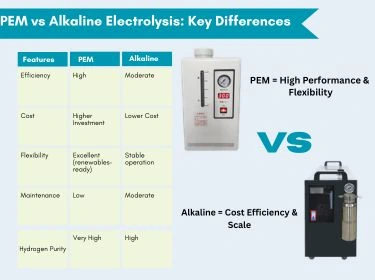
Efficiency, output consistency and operational flexibility are some of the hydrogen production system comparison measures. These aspects are where the controversy concerning the debate over Pem vs alkaline electrolysis is likely to focus on.
PEM systems are usually more efficient as well as quicker in their response time thus able to be used in applications where dynamism is needed. On the other hand, alkaline systems are more suitable in large-scale production that requires cost effectiveness, especially when this is constant.
The other factor that should not be ignored is load flexibility. PEM systems can easily adapt to any variation in the supply of power, whereas alkaline systems generally perform optimally when circumstances are constant.
The other two technologies also have a big role to play in thermal management. Healthy hydrogen cooling in generator systems provides a guarantee of safe operation and elimination of overheating, which may affect the performance and life span.
Finally, the decision between such technologies is based on the application-specific needs such as scale, energy source, and operation conditions.
The most important considerations of the appropriate electrolysis technology are the cost and maintenance. Comparing the PEM vs alkaline electrolysis, one should not only look at the start-up capital but also look at the long term operational costs.
The upfront cost of alkaline systems is normally cheaper, and the design process is not complicated so it is easier to implement large scale industrial processes using these alkaline systems. Nonetheless, they can be more serviced by using liquid electrolytes.
PEM hydrogen generator systems on the other hand are more expensive in terms of initial costs but lower in terms of maintenance needs and more flexible in their operations. They are compact and have sophisticated control systems which render them appropriate in contemporary and automated settings.
The industries are gradually using these technologies depending on the particular requirement. As an illustration, heavy industries tend to be dependent on alkaline electrolyzers whereas renewable energy would tend to be powered by PEM systems.
Both methods are also advancing further via innovations made by companies that are developing Ptxson hydrogen technology which enhance efficiency and increase the number of uses. With the further development of pem water electrolysis technology, it should have an increasingly significant role in the system of hydrogen production in the future.
The comparison of PEM and alkaline electrolysis makes one see the advantages and disadvantages of these methods. Both are based on the use of the water electrolysis technology, but due to the differences in designs, performance, and usage, they are applicable in the various use cases.
The controversy of PEM vs alkaline electrolysis is ultimately resolved by the special needs. Alkaline systems are suitable in the cost-efficient large scale production whereas PEM systems are highly purified, and dynamic operations are feasible.
An in-depth hydrogen production system comparison assists industries to decide on the technology that would best suit their objectives, be it efficiency, scalability, or their compatibility with renewable energy sources.
With new improvements in the alkaline water electrolysis technology, the two systems will likely be better performance and cost-effective. As innovation continues and the need to use clean energy increases, electrolysis technology will be at the heart of the hydrogen economy in the world.