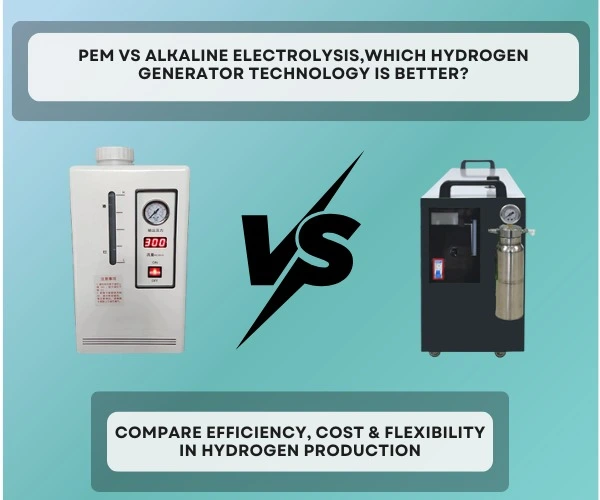
Sterility and chemical stability are absolute in pharmaceutical and analytical laboratories. The ampoule filling and sealing may lead to any contamination that may jeopardize the whole lot of ampoules, patient safety, and critical research outcomes. However, it is common to still find a number of facilities in sealed glass ampule production relying on old LPG or acetylene facilities. These fires commonly result in carbon residues, uneven heat distribution, and severe fire and explosion hazing to the operators. These disadvantages can no longer be overlooked as the size of ampoules and the requirements of purity increase. An ampule sealer of our time needs to provide clean heat, and the ability to control, and to obtain the same results each time. Here is the area of oxyhydrogen (HHO) technology. With a small ampoule that closures labs can do their jobs with a sealing torch that runs on closed demand HHO gas to do the same, thereby making them quicker, safer and with cleaner results. Here, you will get to know how it works, how one can incorporate the same in filling and sealing of ampoules and why it is now becoming the new norm of high-purity production through use of specialized equipment such as an oxyhydrogen quartz ampoule sealing torch machine.
How oxyhydrogen torch works? A type of oxyhydrogen torch begins with the most basic ingredient purified water. The generator has an electrolyzer cell inside of it and separates the mixture of water into hydrogen and oxygen gases in the predetermined proportion. These gases pass through different channels, are mixed in appropriate proportion, and afterwards passed into a burner nozzle where they combust to produce a very focused HHO flame. The size of the gas cylinders and complicated piping is not required since the fuel is produced as required. It is really the quality of flame that is of benefit. During a full combustion of hydrogen and oxygen, there is no by-product other than the water vapor and hence no soot or carbon left on the glass. This renders the process ideal where the traces of contamination must be kept at zero. The oxyhydrogen flame temperature can reach up to 2,800 o C, much higher and more intense than most propane or LPG flames. The oxyhydrogen torch temperature is high to enable quick softening of both glass and quartz to create uniform seals in the shortest time period whilst preserving the contents of the product. Learning about oxyhydrogen torch operations is the initial step on the way to the improvement of your sealing workflow.
With the closing of high-purity glass, the selection of flame source has a direct influence of purity. Traditional flame sealing torch arrangements with LPG or acetylene or other carbon-based sources usually deposit soot that is invisible to the naked eye as they are microscopic. In the case of pharmaceutical liquids, or high-purity quartz ampoule sealing this contamination is not acceptable and can, in fact, compromise the outcome of analysis. Oxyhydrogen gas eradicates this problem because it results in a clean colorless flame which leaves no solid remnant. In addition to being pure, HHO systems are also efficient. The pinpoint thermal intensity enables the operator or automated lines to have more cycles per hour than the typical burners, lessening the process time. The other important benefit is safety. The ampoule sealing machine units produced today produce hydrogen and oxygen to order and only hold a low volume of gas thereby significantly lowering the dangers posed by the high-pressure cylinders. Lastly, the oxyhydrogen technology is highly versatile. The apparatus may be used with normal borosilicate glass, specialty formulations and also with the much higher softening points needed to seal off quartz ampoule. In instances where labs require a faster, more sterile and flexible upgrade, the oxyhydrogen can be a reasonable upgrade to the previous systems.
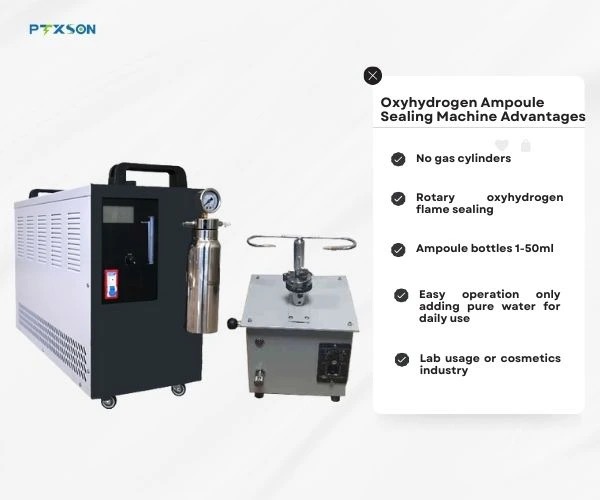
The flame technology, even the best one, cannot remedy bad preparation. The ampuleles have to be washed, dried and sterilized before any heat is added to eliminate particles, residues or microbial contamination. This is a step that must be verified and registered within GMP settings during the workflow of filling and sealing of ampoules. After they have been cleaned, ampoules proceed to the filling station. In this case, precision is crucial: the level of the product has to be low enough to avoid the situation when the liquid could touch the neck. When fluid is exposed to the neck during heating, it may create stress, crack, or even close-up in the locality. R&D and batches with very small sizes are still filled manually, although that requires a high level of operator skill. To gain increased throughput, an integrated ampoule filler and sealer introduces uniformity due to accuracy in dosing and controlled movements and flame delivery. In most current lines, the ampule seale function is fulfilled by an HHO based torch, so that the final action of the procedure is as pure and repeatable as the initial one.
How to seal a glass ampule? It starts with the oxyhydrogen generator. The operators check electrolyte level, purity of water and pressure in the system and activate the unit until the gas output is constant. When this is prepared, the glass ampoule containing the torch is lighted, and regulated so as to produce a steady and narrow dollar-sized beam, which fits the neck of the ampoule. The appropriate length and intensity of the flame provide effective heating and do not cause excessive heating of the glass around.
Later when using tip sealing, the ampoule is positioned upright and turned slowly as the torch burns the very tip of the neck. Since the glass softens, the surface tension pulls the glass inwards to create a smooth and rounded bead by itself. The common types of products that this technique is used on are standard products and sealed glass ampule formats where only a little headspace and simple protection are needed. The bead develops in a short time; it is symmetric due to the clean and concentrated HHO flame.
Pull sealing of ampules is more desirable to achieve greater sterility and increased specifications. In this case, the length of the neck is warmed a little longer until the glass is homogeneously soft. The upper part is then carefully peeled off either by hand or with a basic mechanical apparatus to form a long thin tip with an extremely tight seal. This technique is very good in terms of integrity, and the technique is frequently used with injectable drugs or sensitive reagents.
How to vacuum seal ampules? Where the products are oxygen sensitive, laboratories use how to vacuum seal ampules techniques. During neck heating, the ampoule can be filled with inert gas or it can be attached to another system of vacuum. The collapsing of the softened glass into a hermetic closure with a low amount of trapped air is achieved as internal pressure is controlled. Knowing how to seal a glass ampule with a glass ampule HHO torch makes the laboratories flexible to work with both the standard, pull and vacuum configurations of a single energy saving system.
A steady hand is not sufficient to meet hermetic sealing requirements of samples in the laboratory. Hand working of the torches may experience irregular heating, fluctuating rotating speed and the exhaustion of the operator. Many of these drawbacks prompt many facilities to use special oxyhydrogen ampoule sealing machines that are intended to be repeatable. The core difference between these systems and the manual benches lies in the fact that they have the same clean HHO technology, but it is supplemented with accurate motion control and safety consideration that the latter lack.
Glasses with varying degrees of thermal expansion and softening behaviors include borosilicate, neutral and quartz glasses. The sealing system should provide strict control of temperature profiles to prevent stress fracture and leakages. Special types of machinery make sure that the heating is uniform around the circumference and that the wall thickness at the point where the seal is to be made is consistent, a vital aspect of a good vacuum glass seal ampule. High-value contents last longer in the shelves due to temperature control and attentive rotation that minimizes internal stress.
Oxyhydrogen flame often burns at 2,800 C or higher, and gives sufficient power to soften even quartz without adding any chemical contaminants. Since the combustion provides nothing except water, the flame does not color glass or leave any sort of deposit that would interfere with analysis. HHO units have a cleaner combustion, an easier ignition process and less complex infrastructure than the traditional fuel systems which burn propane or acetylene. They also remove the storage logistical problems and risks of having huge fuel cylinders.
3.1 Manual Single Flame
The set up involves a stand or a basic holder used to hold a hand-held torch. Each ampoule is only manually rotated and positioned by operators. It is most appropriate in a research scale work and small-sized batches where flexibility is of more importance than throughput.
3.2 Movable Type
In this case, the hand held torch is fixed on an adjustable arm, which enables more control of position and angle. With a more consistent motion of the ampoule, this type offers superior repeatability to a fixed torch at relatively low cost.
3.3 Double Flame Type
The ampoule sealing machines with a double flame operate with two synchronized burners, and they provide a higher degree of uniform heating of the ampoule, which makes them suitable in formats of the 1-25 ml range. The operator still retains the ability to control the flame intensity, location and timing of the cycle and still gain access to automated rotating and heating programs, making it a balanced system capable of aiding in developing processes with precision, as well as producing efficiently in pilot and mid-volume volumes.
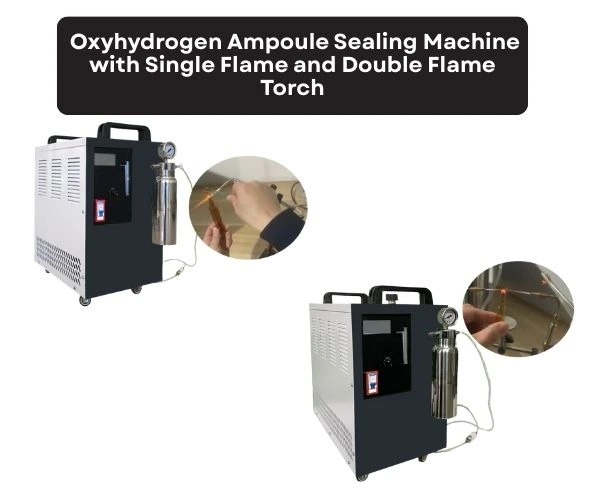
3.4 Rotary Double Flame Type(Semi-automatic)
Rotary double-flame ampoule sealing machine is a high-level semi-autonomic system that is a combination of oxy-hydrogen flame heating and rotation. In this technique, ampoules are held on clamps and rotated at constant speed mainly 50-200 rpm with two oxy-hydrogen burners applying an even heat around the neck circumference. The twin flame burners have more HHO gas capacity than the single-flame which allows them to have high sealing rates and predictable quality outcome in batches.
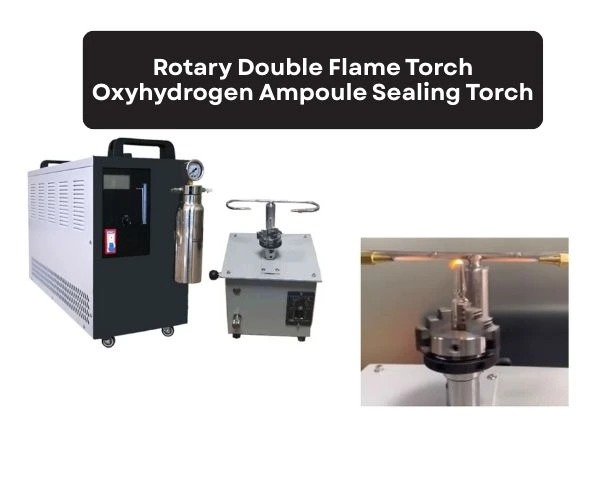
The most common principle of the rotary sealing process is the fact that it is a push-pull working principle: the operators enter the ampoule in the heating area, and the rotating process is self-assured to eliminate ununiform melting and fusing of the glass neck. This semi automated technique enhances the sealing efficiency with the operators having control in placement and timing. The resulting seals are also much smoother and uniform in size, compared to the manual or single-flame process, decreasing the limitation of the defects and enhancing other visual features.
In increased quantity production, auto indexing of sealed ampoules in and out of the working chamber may be used as the carousel and the conveyor systems may be joined together in a way that new containers get loaded at one end and get unloaded at the other end without the operator having to re-prime the working chamber in between. This enables making the sealed ampoules in the thousands with a consistent set of sealing parameters, such as rotation speed, flame intensity, dwell time, and cooling conditions, over a lengthy series of production. The accuracy and consistency needed by the pharmaceutical compliance is found in the system, and the automated documentation provides traceability and an ability to prove that all the production was not outside the set parameters.
Dual-flame design is especially applied where ampoule sizes are large and during the production process a large volume is needed or the production process is pilot and flexibility and reduced equipment cost are of importance as only a small volume is needed.
Rotary double flames are the highest productive and most consistent sealing systems of all ampoule sealing systems and are the most used by manufacturers who need an industrial-scale operation without sacrificing on the high quality standards or maximizing operational efficiency in pharmaceutical, laboratory and specialty chemical industries.
In spite of automated equipment, there are several common problems that should be mentioned. The overheating may trap the gas and form bubbles or weak spots in the seal; the underheating produces thin and fragile closures which can easily break in transport. In case of splashing of products into the neck, the cracking of capillaries during the process of cooling is frequent, and, therefore, the fill height should be carefully regulated in all ampoule sealing methods. On the safety side, operators must always use heat-resistant gloves and face protection including face protection, such as lenses, to cut the sodium flare in working with bright HHO flames. Periodic inspection of cooling and nozzles and electrolytes can maintain the performance and machine life. The easiest methods to maintain the safety of the staff and product quality are regular maintenance and calibration.
The Oxyhydrogen torch technology presents an ampule filling and sealing of ampoules process with a strong combination of speed, sterility, and precision. Laboratories and manufacturers can also utilize the opportunity to reduce the risk of contamination by a considerable margin by substituting carbon-based burners with clean HHO flames and by installing specifically designed ampoule sealing torch systems, which will enhance throughput in effect. These benefits are no longer nice to have but must now be considered as necessities given the increased regulatory expectation and formulations being more sensitive. In highly stakes industries such as pharmaceutical, biotechnology, and advanced chemistry, oxyhydrogen based ampule sealer seating arrangements are becoming the best in town. This would be the most appropriate moment that the facilities that continue using LPG or acetylene should review their infrastructure and put in mind a replacement with modern HHO hydrogen generators that would protect both the products and the people.