Hydrogen has emerged as one of the habitually used gc carrier gases in present day laboratories. It has a high diffusivity and low viscosity, as well as an optimal linear velocity that supports faster separations without losing its resolution. Hydrogen allows shorter run times and better shapes due to a higher peak compared to helium or nitrogen, and this is particularly useful where more peak is required, e.g., pharmaceutical quality control, environmental testing, petrochemical analysis, and in academic research laboratories.
In addition to performance benefits, helium supply volatility and the rising global costs are compelling hydrogen to gain more and more appeal. Supply strategies are now being looked upon more critically than ever in laboratories that are dependent on gas chromatography heavily. This has created a great controversy concerning the use of hydrogen carrier gas cylinders vs gas generator systems.
Historically, hydrogens were supplied in pressurized cylinders. Nonetheless, technological innovations have brought in the lab gas generators that have the capacity to generate hydrogen as and when needed. These are special systems that are used as a hydrogen generator for gas chromatography, where there is a continuous, controlled flow of gas directly to GC instruments.
Comparing the methods of supply, labs need to assess reliability, purity, cost of operation, safety, and compatibility with automation. All of these are important factors in identifying the most feasible solution for the present-day chromatography operations.
Over the decades, GC carrier gas has been supplied in compressed gas cylinders. The hydrogen cylinders are supplied in various purity grades that are normally between 99.995% to 99.9999%, depending on the analytical requirement. These cylinders are linked with pressure controllers and gas lines, which feed gas into chromatographs.
Hydrogen as carrier gas in gc systems has been found effective and reliable in most facilities. The Cylinders give certain specifications of purity, and the supplier takes care of the refilling logistics. Nevertheless, some weaknesses are involved with dependence on outside deliveries.
Key challenges include:
Hydrogen compressions need to be stored with safety measures, which may need specialized ventilated facilities and barriers. Transportation of heavy cylinders poses physical danger and inconvenience to the operation in a busy laboratory setting.
Otherwise, the change in prices of compressed gases in the market due to fluctuating costs may raise the long-term operating costs. Although cylinders are still widely used, laboratories are also doubting their efficacy in a long-term strategy.
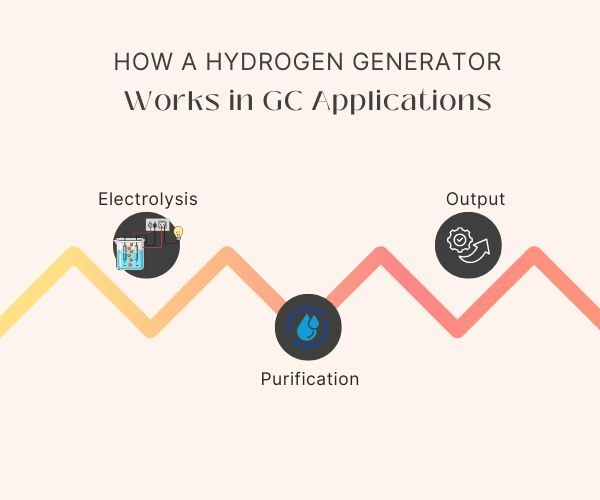
The hydrogen generators will provide a totally different solution. Lab gas generators do not store hydrogen by the pressure method but rather generate it by the electrolysis of pure water. The produced gas is fed into the GC system directly at regulated flow rates and pressure levels.
Hydrogen generator for gas chromatography work by separating hydrogen and oxygen molecules from water molecules through a proton exchange membrane (PEM) or some other type of electrolysis technology. The hydrogen stream gets dried and filtered and is provided at high purity that can be used in analytical applications.
This on-demand method of generation greatly increases the workflow performance. Hydrogen is also generated upon demand; as a result, no external amenities are needed to change the cylinders or deliveries. The perpetual supply also helps in the laboratories and ensures that there are no breaks in supply, especially during the night or the unattended GC runs.
Generators are typically small bench-mounted generators that can be easily fit in the analytical laboratories. They save on space used on the floor and eradicate the logistical bottleneck of having to provide gas cylinders.
With the use of automation and trends of location Laboratories becoming 24 hours operation, on-site generation is gaining more attraction.
Several sophisticated systems are designed to be used in chromatography. An example is the Lab Hydrogen Generator 500 mL at Ptxson, which is a small-sized generator that can fit in a small to medium-sized laboratory. Being built to provide a certain stable, predictable production, it does not have to rely on external supply chains to perform steady GCs.
When extremely high purity hydrogen gas generator, it is geared towards high-levels of analytical requirements. With high purity hydrogen gas generation ability, it provides a stable characteristic in output with a very low level of impurity, thus it is applicable in sensitive detection devices.
In general, the modern hydrogen generators for GC combustion detector applications may include:
Specifically, they are an ideal use as a hydrogen generator in applications such as GC combustion detector systems, in which flame ionization detectors (FID) or other combustion-based detectors need a stable hydrogen flow. Constant purity provides the stability of quantification and reproduces chromatographic scores.
The flexibility of hydrogen production in response to laboratory requirements allows the systems to be used in routine and sophisticated GC workflows.
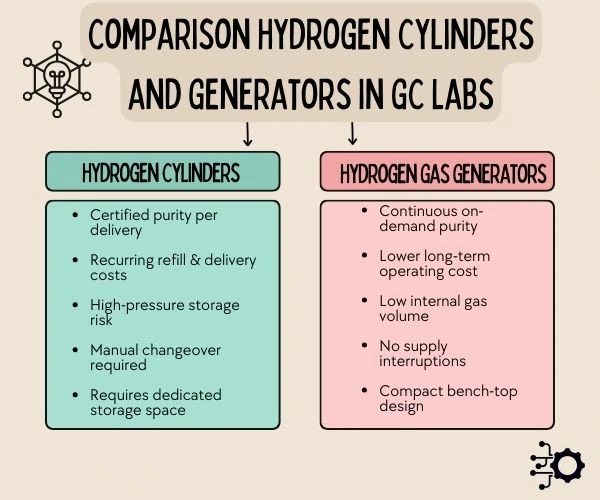
In comparing hydrogen carrier gas cylinders vs gas generator, there are a number of factors of concern in laboratories.
Cylinders offer certified purity at the time of delivery, but containing impurities can vary among suppliers. Accurate production of hydrogen at constant purity levels is made available by generators, which are usually suitable for most GC use.
Cylinders imply the repetitive purchase and delivery costs. Refill costs are enormous over a number of years. Generators cost more to invest in, but reduce the operational costs in the long term, especially for high-consumption labs.
High-pressure hydrogen is contained in high-pressure compressed cylinders, that make it more dangerous in case of leakage. Low pressure and low-volume Hydrogen generation is generated by generators, minimizing the hazards of storing gas.
Experiments may be interrupted due to cylinder depletion as a long analytical run runs. Generators mitigate supply interruptions and allow automated and unattended GC sequences.
Cylinders need a unique storage facility and maintenance of regulations. Generators are fitted in the benches of the lab.
In the case of laboratories that value efficiency and automation, gas generators can be beneficial in terms of operation. Nevertheless, small laboratories with low hydrogen consumption could still make the use of cylinders cost-efficient.
In laboratory environments, which are real-life settings, decisions are seldom made based on theory only. Opinions on gas supply are usually subject to practical concerns.
Common questions include:
To consider a transition towards on-site production, many researchers look for answers to the question of generating hydrogen gas lab answers. The majority of the current systems can be easily integrated by plugging in with limited intervention from an operator.
Usually, what is required is periodic maintenance by way of water filling and changing filters. This is less difficult than the handling of the cylinders, and it eliminates the risks of manual labor.
It is also important to have service support. Some reliable manufacturers offer remote diagnostics, warranty, and access to spare parts to ensure continuous lab activities.
Finally, the presence of performance reliability and responsive support is what defines user satisfaction in the long term.
A decision as to whether hydrogen carrier gas cylinders vs gas generator are implemented is based on the size of laboratories, working load, safety practices, and financial considerations.
Cylinders can be useful in:
Nevertheless, the cost of a hydrogen generator in gas chromatography can also be beneficial in:
Since the development of hydrogen generator for gas chromatography is in progress, they themselves are becoming head-end structures of the modern analytical infrastructure. Improvements in the controllability of purity and control of the safety system are facilitating increased usage in industries.
In the future, the sustainability demands and the issue of helium supply are always going to increase the pace of the adoption of hydrogen. On-site generation is in line with the tendencies of lab automation and improves operational resiliency.
To laboratories interested in efficiency, reliability, and safety, hydrogen lab gas generators are not only an option, but the future of GC carrier gas.