In highly specialized laboratory studies, the physical, chemical or structural characteristics of sensitive materials are likely to change as the result of a short exposure to oxygen, moisture and atmospheric contaminants. Unwanted reactions can occur in the presence of air, materials can be hygroscopic, or reactive compounds may oxidize, causing problems in a battery, semiconductor, catalyst or rare-earth material. Hence, for this purpose otherwise, it is essential to have controlled sample handling and storage whenever researchers need to keep certain properties of the samples between preparation and experimentation. The preparation of air-sensitive material sample preparation is therefore critical to a variety of research applications that involve special semiconductor materials, specialty materials, catalysts, energy storage compounds and advanced material applications, and hold reactive chemicals and compounds.
A method that is used is to set up the material in a quartz ampoule, get rid of the atmospheric gases and then seal the tube. Quartz tube vacuum sealing offers a closed environment which can help to isolate samples from oxygen and moisture preventing them during storage, transport, and the subsequent laboratory investigations. Sealed quartz ampoules are especially useful for materials that will be subjected to controlled heating and/or high temperature treatment in the future, with respect to their excellent thermal resistance, chemical stability, and transparency.
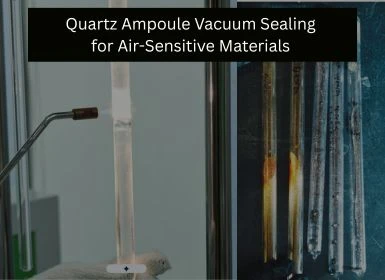
Sealing ampoules with quartz involves using a short section of a quartz tube or ampoule in a precision lab process to soften and collapse the glass into a seal at the end of the ampoule. With proper evacuation or inert-gas treatment, the evacuation process establishes an isolated environment surrounding a sample when the process is performed after inert-gas treatment. It would therefore be beneficial for the purpose of Oxygen-free sample sealing, particularly for sensitive samples, and for the purpose of reducing contamination of the environment before the sample is analyzed or further processed if the sealing takes place in the absence of oxygen.
A glove box is typically used for working in a controlled environment. An enclosed chamber keeps oxygen and moisture levels very low, ensuring that air-sensitive samples can be weighed, mixed, transferred, loaded, prepared, and other tasks performed by the researcher without the samples coming into contact with normal laboratory air. The glove box sample preparation is especially significant in dealing with chemicals, compounds that are susceptible to the presence of moisture, battery electrode materials, organometallic compounds, and material whose property can change rapidly in the atmosphere.
But a glove box and a sealed ampoule are not used interchangeably. The glove box is used to maintain a controlled working place and vacuum sealing would make the sample container physically ‘closed’. When it comes to glovebox vs vacuum sealing, this distinction plays an important role in its understanding. A sample can be made and placed in a glove box, which can then be removed to a quartz ampoule for evaporating off the volatiles and sealing it permanently. With this workflow, Air-Sensitive Material Sample Preparation takes place in an inert atmosphere, with long term protection away from the external environment achieved by the following ampoule sealing step.
Therefore, vacuum sealing can serve as an extension to glovebox operations and not an alternative to it. The glove box is used to protect sample during use and the quartz ampoule is used to maintain the condition of the prepared sample. The researchers can use a combination of vacuum sealing, inert-gas backfilling or both depending on the experiment and material.
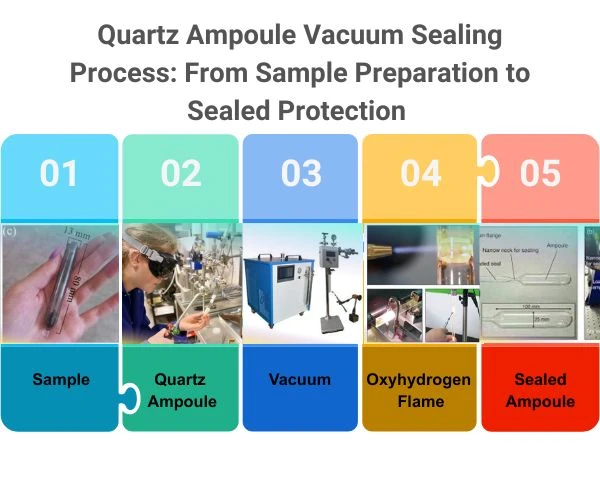
A standard quartz ampoule sealing process starts with precisely preparing a sample and loading it into the ampoule. This material is then packed into a quartz ampoule that is clean and compatible. There is enough empty tube length above the sample to connect to the vacuum system and the ampoule is then sealed. Cleanliness is extremely important because residues that remain in the tube can be permanently trapped in the tube with the sample.
An ample vacuum system is then attached to the ampoule. Air or other gases being removed from the inside to create the needed pressure conditions. Depending on the material and the experimental goals, other evacuation and purge cycles can be repeated to further decrease the atmosphere contamination. A great deal of care must be taken when creating an anoxic oxygen-free sample sealing environment when even low levels of oxygen or moisture may impact the sample.
Finally, the desired vacuum state is attained and the quartz tube vacuum sealing has a controlled place heating with a flame. When heated, the softened portion is drawn to the adjoining walls of the tube and permanently seals it closed. Careful adjustment of the heating, the rotation of the tube and its sealing position allows production of a constant closure whilst reducing unwanted thermal exposure of the sample. This is where quartz ampoule sealing is not just a step in glass making but a precise process.
Vacuum sealing effectively delivers long-term physical separation and can minimize the amount of contamination before/after storage and shipping into the quartz tube. In addition, if the samples are to be subject to further high-temperature treatments, the sealed ampoule normally can offer a controlled inertial environment during the thermal treatment.
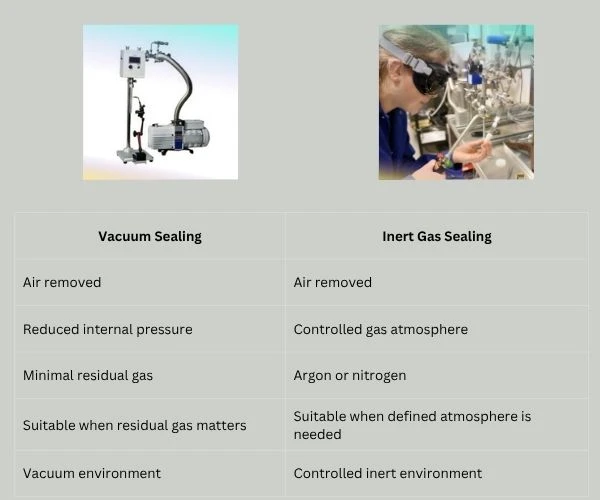
For top performance in laboratory compound storage, vacuum sealing or inert gas sealing needs to be taken into account. Vacuum sealing eliminates gases from the ampoule and inert-gas sealing is done, in general, by evacuating or purging the tube from gases and then filling the tube with a controlled gas, often argon, or nitrogen, and sealing the tube.
It can be useful to use a vacuum seal if there is residual gas which may affect the sample or the experiment. It is often used for materials that need to be protected from atmospheric exposure, materials which can be exposed to a vacuum environment, and materials for storage in environments where oxygen and moisture should be reduced. But not all materials should be stored under vacuum. The reduction of pressure or the use of a defined inert-gas atmosphere could be combined with some of the samples used.
Inert-gas sealing can offer a shielding effect, and simultaneously also control the gas pressure in the ampoule. But for especially delicate materials, argon may be the preferred choice due to its inert chemical properties and nitrogen may be used where it will not react with the sample. It depends upon the nature of the material, the temperature, the pressure to which it will undergo, the storage time and the next experiment to be performed.
Both methods an oxygen-free sample sealing, but have different internal sample environments. For applications with a requirement of a controlled gas atmosphere, an inert-gas sealing can be preferred. Quartz ampoule sealing could be a viable option where the atmosphere needs to be reduced. In both, preparation, atmosphere to be used, manner of heating, and the nature of the sealing are important factors to be closely controlled.
The PTXSON Oxyhydrogen Quartz Ampoule Sealing Machine is made specifically for use in the laboratory where quality and control are paramount for sealing quartz tubes and ampoules. The system heats a quartz flame to the proper softening point in the area where it is needed to seal, via an oxyhydrogen flame. The use of high temperatures for effective processing makes a stable, controllable flame critical for quartz.
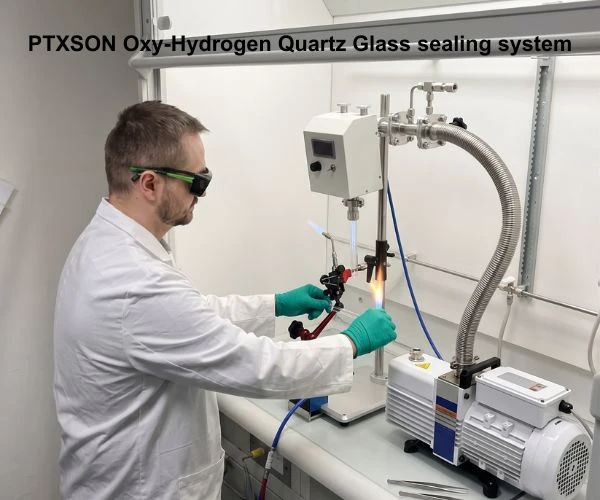
An important feature is the rotatable vacuum ampoule sealing device, giving the quartz tube a rotation function for the case of the local heating. Rotation can help spread heat evenly around the circumference of the tube allowing the operator to form a uniform seal as well as a more uniform softening. When using small diameter laboratory tubes or samples which need accurate sealing points, controlled movement and flame positioning are especially critical.
The machine is suitable for various types of research settings for quartz ampoule sealing. Sealed quartz tubes are suitable for use by semiconductor laboratories for studying sensitive material preparation and thermal studies. Sealed ampoules can be used in battery researcher applications for the study of reactive electrode and material systems, and also as a means to prevent atmospheric exposure to prepared catalyst materials in battery research. These types of workflows can be applicable to rare-earth material research, creation of advanced materials, and university laboratories with experimental chemistry and materials science work.
The PTXSON Oxy-Hydrogen Generator generates on-demand supply of hydrogen and oxyhydrogen gas generator to produce an oxyhydrogen flame. The system is different from the ones which are available in the market and these are the ones which produce hydrogen and oxygen from water by electrolysis but only when needed. The gas mixture obtained can be fed into an appropriate torch system for a controlled quartz process.
In laboratory sealing applications, an oxygen hydrogen flame generator, properly configured for the sealing equipment, can provide a steady source of flame. The selected part of the quartz tube is subjected to the oxyhydrogen flame and the heat will be focused on the desired area which will cause the material to soften, thus forming the closure. Thus, it could be a worthwhile addition to a comprehensive quartz sealing system.
The stability and controllability of the flame is important since the sealing of quartz ampoules involves selectively heating a small portion of the sample and not its entire cross section to a high enough temperature. The operator should consider the capacity, flow rate of the gas, the configuration of the torches, flame adjustment, properties of ventilation and installation requirements for the generator. The vacuum system will regulate the inner atmosphere of the ampoule and suitable equipment selection may be able to help ensure a repeatable oxyhydrogen flame during sealing operations.
The gas-generation system and sealing apparatus can be seamlessly adopted to establish a quartz tube vacuum sealing process in the research laboratory where repeatability and control of the heating process and protection of the material were key considerations.
Sealing is commenced with great success before the flame is applied. Reliable results are achieved through clean quartzware, proper loading, proper air control and appropriate vacuum equipment. Air-Sensitive Material Sample Preparation starts with minimizing samples’ contact with oxygen and moisture via minimizing contact wherever possible. Preparation and transfer should be carried out under a controlled glove box or a different validated inert atmosphere, as appropriate.
Prevention of contamination is also a key concern. The surface should be kept clean for good sealing, where the softened quartz will form an effective closure.
However, proper oxygen-free sample sealing in an oxygen-free environment must be attended to at every step, ranging from loading the sample to evacuating it, up to its last sealing and storage in the container. The finished seal should be tested to ensure its mechanical integrity and capability to withstand anticipated temperature and pressure. Quartz ampoules, samples, internal atmosphere and experimental conditions should be checked for their compatibility especially with high temperature experiments.
Finally, quartz tube vacuum sealing is a useful technique for advanced scientific research due to the combination of isolation and control of sample and the ability of quartz to withstand the extremes of temperature. Researchers know the difference between Vacuum Sealing vs. Inert Gas Sealing, and can choose the right atmosphere for their material/experiment. When used in combination with controlled Air-Sensitive Material Sample Preparation, accurate sealing of quartz ampoules may contribute to the integrity of the sample, minimize contamination, and create a secure environment for an application involving heavy materials research.