Acrylic fabrication is the art whereby the final look of a product can be what determines the quality of a product to the customers. The clarity of visuals in perceived value is significant whether it is in applications of retail displays, signage, protective covers, furniture panels, or architectural features. The acrylic may be carefully cut and sculpted, but with rough or opaque edges, the acrylic is automatically reduced to a lower grade.
That is why, admitting the acrylic edge finishing process is the significant step of the production. The manufacturers know that smoothed edges not only enhance beauty, but also enhance customer confidence in the work completed. An acrylic edge finishing workflow of a clean finish has a direct impact on the level of acrylic item that will be perceived in the marketplace.
The acrylic fabrication finishing process is not yet an option in most production settings. Critical as a milestone towards attaining competitive product quality, enhancement of visual consistency, and expectations of the present day buyer it is now a crucial step towards fulfilling these.
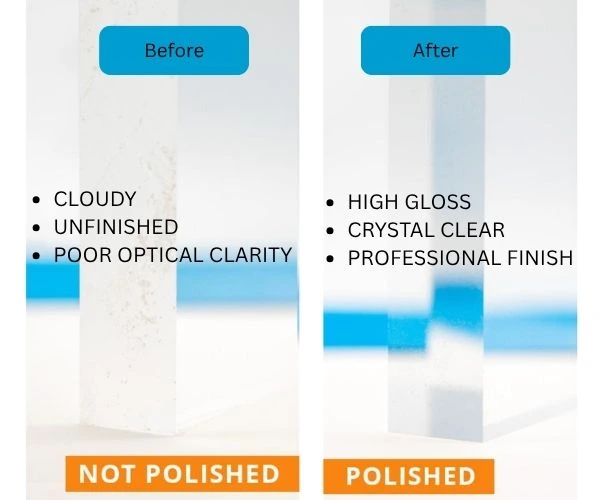
Newly-cut acrylic edges appear hazy, coarse or partially frosty. Saw blades, CNC routers and laser cutting systems can make fine shapes but the resulting edge typically has small surface irregularities which diffract light and make it non-transparent.
Unless the acrylic surface treatment accordingly, these defects are visible, and may render even good-quality acrylic products to look unfinished. In business where the looks matter a lot, un-treated edges usually decrease the perceived professionalism of the final product.
This is the reason why post-processing acrylic fabrication is important. A dull edge can be put in the right finish to have a crystal clear edge finish, which once more provides the optical clarity, and makes the edge look more polished. Flame polishing plexiglass in most of the workshops is now one of the most convenient methods to achieve it.
Lucidity and smoothness Thermal finishing Acrylic flame polishing is a thermal finishing method employed in an acrylic fabrication to enhance the purity and cleanliness of edges. Rather than mechanically sanding the material, a hot flame is short-lived to heat the acrylic edge before the microscopic surface peaks become soft, and stream together to become a smooth finish.
This type of thermal polishing method succeeds since acrylic gets soft as soon as there is localized heat. An even temperature distribution of the flame obliterates all fine machining marks and leaves a smoother and clearer surface.
Due to its speed and efficiency, flame polishing plexiglass is popular in acrylic shops, display factories and factory fabrication industries. It provides an effective way of finishing both small custom jobs as well as larger production batches.
The optical finish that is produced by flame polishing is one of the primary reasons why flame polishing is a more desirable process. A well polished edge is transparent, glossy and visually polished. This is more so critical in the contexts whereby the appearance of the product is directly influenced by the visibility of the edges.
Crystal clear edge finish enables light to cleanly go through the acrylic that contributes towards high standard appearance of the finished work. High-gloss acrylic surface that results provides products with sleek and classy look and is hard to come by using roughly cut edges, or slightly sanded edges.
Such high quality of professional-grade finishing is very popular in retail display furniture, lit signs, museum cases, upscale interiors and architecture grade acrylic panels where looks equal to structural accuracy.
Whether to use mechanical polishing vs thermal polishing can be based on the priorities of production. Mechanical polishing typically deals with sanding, polishing and various abrasive processes. It can also provide satisfactory results, but it may take a lot of work and take a lot of time to process.
Relative to flame polishing, it has quicker finishing, and few process steps. One controlled flame pass can often accomplish an acrylic edge finishing process with a requirement of multiple mechanical polishing processes.
Flame polishing plexiglass has been used to provide greater benefits when needed with high-throughput production. It saves on labor, minimizes the cycle times and gives thermal finishing a much desirable uniform optical clarity- making thermal finishing particularly appealing to industrial acrylic fabrication.
The equipment used is of great importance when trying to achieve the same results of flame-polished. Even the stability of the flames, accuracy of heating and easy operator actions all have effects on the end result of the edge.
A skilled acrylic flame polisher needs to produce a steady and focused flame that will have the ability to soften the edge yet should not be too hot. Bubbles, edge distortion or surface whitening can be defects in case of an unstable flame that is too aggressive.
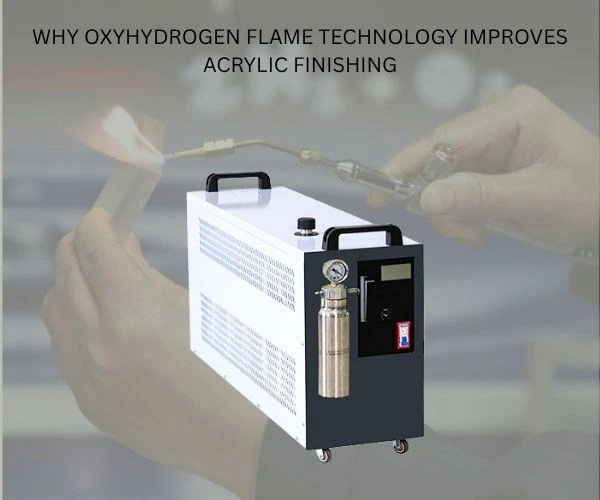
This is the reason why numerous fabricators buy a dedicated flame polisher for acrylic instead of the generic gas torches. A special acrylic flame polishing machine enhances consistency, minimizes error on the operator side and helps promote more constant acrylic fabrication finishing process amongst production batches.
One of the areas of modern acrylic finishing that is enjoying the benefits of oxyhydrogen flame is modern acrylic finishing. A case in point is the oxyhydrogen flame polishing solution that Ptxson has come up with that is specifically intended to be used in finishing processes that rely more on the precision of the flame.
Ptxson is an acrylic flame polishing equipment supplier, which sells systems that produce hydrogen and oxygen using the water directly by an electrolysis process. This gives it a clean and steady flame with minimum contamination as compared to the traditional fuel gases of hydrocarbons.
In the case of acrylic fabricators, this translates to improved edge finishing, less carbon left behind as well as better flame behavior. In the workshops that are in search of energy efficient polishing with a constant heat output 300l polisher portable oxygen hydrogen water welder flame polishing machine is particularly appropriate. An acrylic flame polishing machine that has been properly designed will enhance productivity and at the same time not compromising on the high optical finishing standards.
In modern acrylic markets, the quality of finishing – a competition attribute of the product has become a key element of competitiveness. Clean edges boost attractiveness, are a way to enhance perceived value and help build greater customer trust in the end product.
The finishing process of a modern acrylic form of fabrication should compromise speed, consistency and optical performance. flame polishing in acrylic fabrication produce just such a combination to many manufacturers. It offers high speed of completion, high degree of clarity as well as repeatability in a broad spectrum of acrylic products.
Advanced finishing systems will become even more important as more and more uses of acrylic applications are created in architecture, retail and electronics, and custom fabrication. It is on this account that acrylic edge finishing is one of the most crucial funds outlay in the production of high-quality acrylic.