Heavily regulated heat is employed in the jewelry manufacturing welding industry, where it’s used to join parts together, solder, heal parts, repair fragile areas, and melt precious metal. When comparing the jewelry industry with larger industrial fabrication projects, some of the items built may be small and when using too much heat, it could have a negative impact on the surrounding areas or on the jewels, the finish, the setting or on very thin sections. The heat source thus must be the appropriate size and sensitivity for the application.
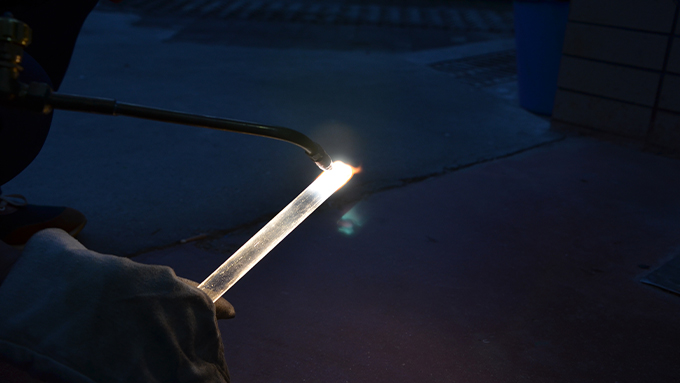
An oxyhydrogen flame for jewelry is one which does not require any conventional fuel gas heating of the flame because hydrogen and oxygen are obtained from the electrolyzer and supplied to the torch for burning. Depending on the type of generator, torch and nozzle combination will be used, the type of flame can be altered to perform a specific job for jewelry application. Refining, remelting or platinum melting of precious-metal materials, fine joining, oxyhydrogen jewelry soldering with oxyhydrogen, and repair are the other industrial uses.
The technology is especially useful in the case of small workpieces in a workshop that requires a focused heat source. A hydrogen oxygen flame jewelry system can be equipped with various torch tips of internally different capacity levels and thus the operators can choose a proper flame for the specific component and task, instead of the same fixed flame size. Jewelry manufacturers and repair shops have been utilizing oxyhydrogen systems for gold, silver and platinum work, but the type of system to use is dependent upon the type of joint work, material size and heat input needed.
The four main applications are: oxyhydrogen platinum welding, gold jewelry soldering, repair and gold scrap melting. In evaluating an oxyhydrogen system for a jewelry workshop it is important to know what is the difference between these operations.
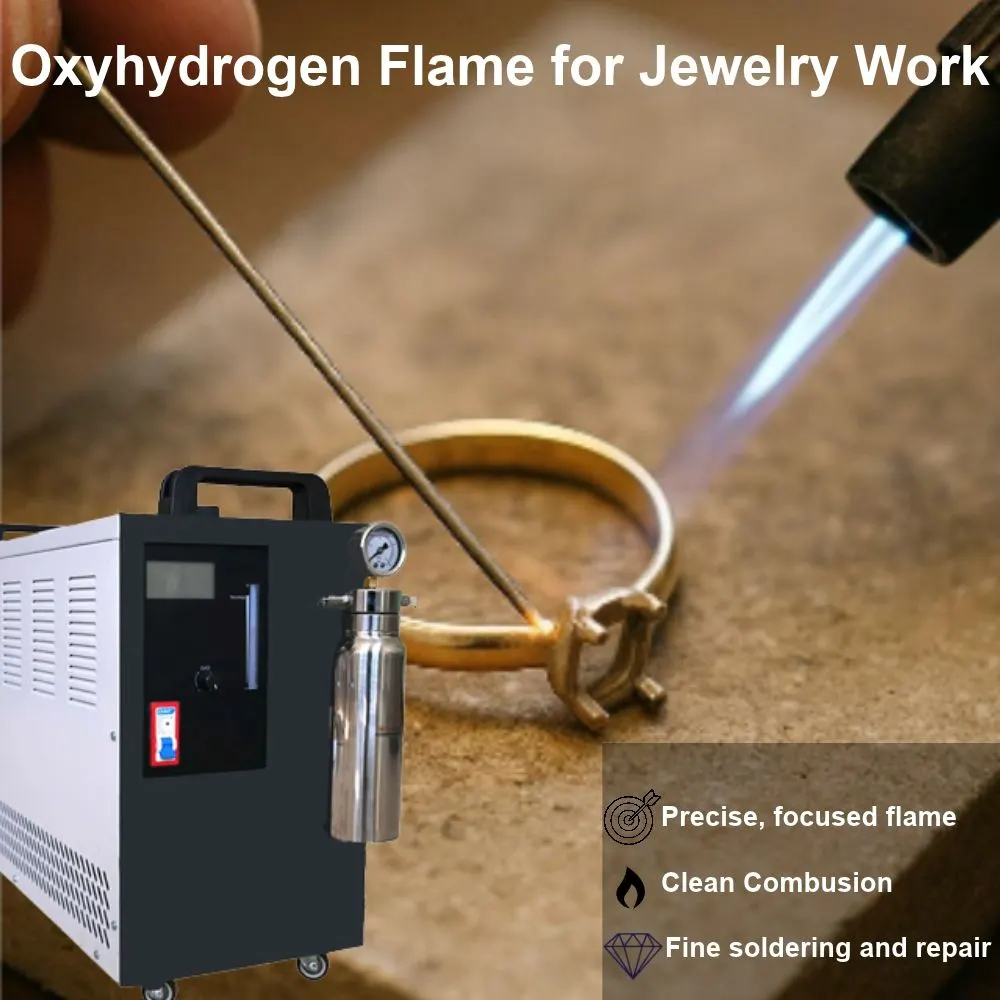
The main idea of the oxyhydrogen flame jeweler welding machine is their capability to provide a focused heat source to comparatively small work spaces. This makes it applicable to both jewelry production welding and repair processes and the person operating it could want to heat a joint without heating up the whole piece of metal.
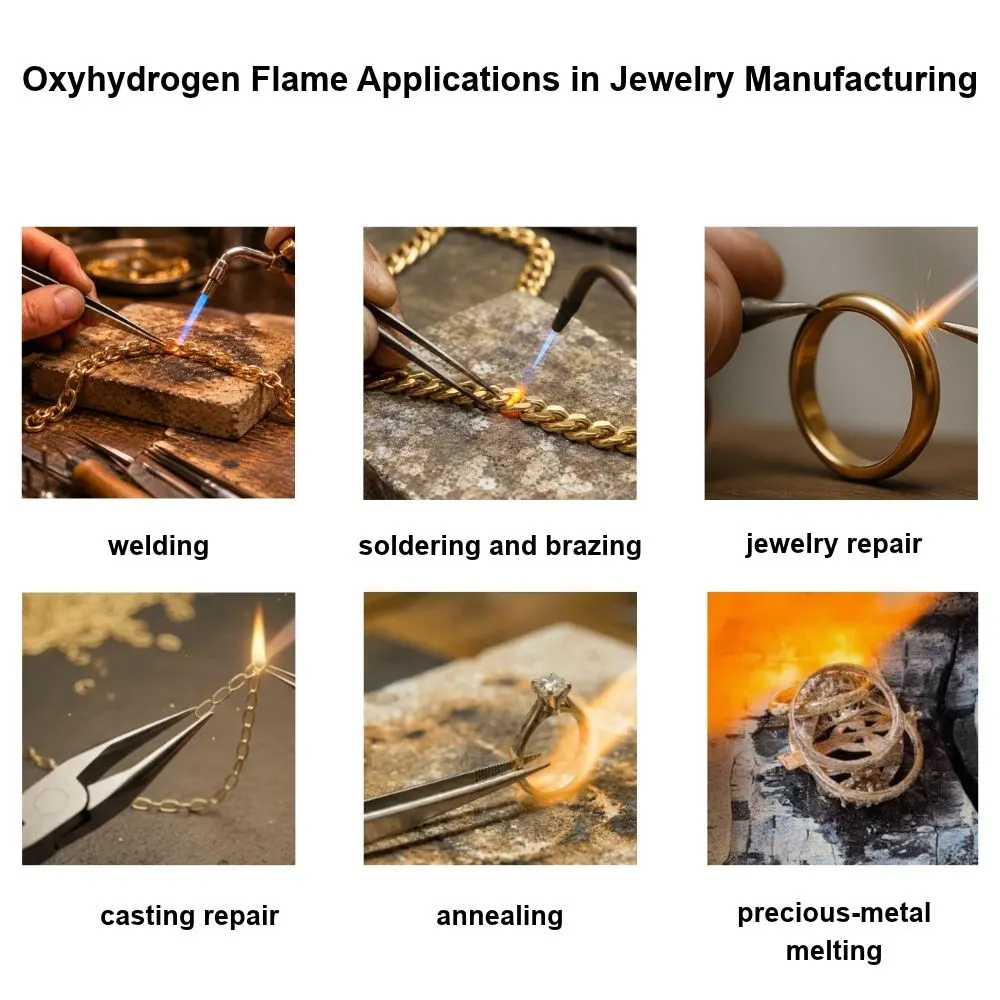
Welding of jewelry is applicable to joining two parts together by melting the base material locally, and in some cases using a suitable resident material as well. Useful for the fusion process for fine components when a localized fusion process is appropriate. Oxyhydrogen systems used in the industry describe those systems that burn gold, silver and platinum items—whether those are fine wires, chains, clasps, or small pieces.
Gold jewelry welding with oxyhydrogen is applicable in production for very fine assemblies or components where proper application of heat is important. In the case of silver jewelry welding / silver jewelry soldering, it can also be advantageous to have a controlled flame where appropriate components are silver. Again due to the higher working temperatures and heat behaviour of platinum, there are process considerations that need to be unique when having to consider it. Usually jewellery professionals use hydrogen/oxygen flames for soldering or joining platinum applications.
Hydrogen oxygen jewelry welding does not look into only high temperatures. Shape, size and intensity of flames, heat input, joint geometry and material of the products must correspond to the joints to be welded. Consequently, fine jewelry welding relies not only on the heat source but to a large degree on the skill and control of the flame, and the work technique.
Soldering and welding are not synonymous. Platinum jewelry soldering involves the use of a filler alloy that will melt, and flow into the area of the solder joint, and the melting areas of the primary jewelry alloys are kept below the solder’s melting temperature. In welding or fusion joining, the base material, on the other hand, is melted at the joint.
This is especially crucial with regard to jewelry items and jewellery as soldering is common in jewelry component joining assembly and fixing. Rings, chains, clasps, posts, bezels and other pieces of jewelry soldering can be used. An oxyhydrogen flame soldering application can offer a concentrated heat source which enables the operator to direct the heat towards the joint and control the affected area.
A case in point is platinum jewellery. Hydrogen/oxygen as the heat source for platinum soldering/ welding is recommended by the jewelry-industry and is the technique that would depend on the alloy, joint, and fill material.
Repair work specimens are particularly sensitive, regarding localized heat, as the jewelry around the specimen can have already been finished with surfaces or given a jewel, as a joint that was soldered earlier.
Ring repair, chain repair, clasp repair, prong repair and fine-component repair are some of the possibilities of applications. Using a precision flame may be able to focus the heat within a particular area instead of scattering heat widely across the item.
The controlled flame is used by a repair shop for gold jewelry repair, for part or all of the ring joint, when the piece of jewelry is being resized or when it’s a damaged component that needs to be fixed. Silver jewelry repair can include everything from chain links, slides or other decorative pieces, and platinum jewelry repair demands a careful control of heat and any contamination due to the unique qualities of platinum in terms of thermal and material properties.
It is, therefore, necessary to have a nozzle size selection function. There are tip shapes available for dollar systems designed for jewelers for precision oxyhydrogen jewelry soldering, micro-work and larger components.
Ideally, casting results in a true finished part, though it does not always. Localized defects such as small holes, localized porosity and incomplete areas are sensitive defects which might need localized correction, before finishing.
In some jewelry processes a localised casting repair process can be executed using an oxyhydrogen flame for jewelry, including the filling of small defects with suitable material. In particular, industry sources refer to oxyhydrogen equipment aimed at the repair and casting filling of the very small casting defects.
What matters is the size of the vector. Sometimes a mere defect can be treated with a smaller heat source, and for larger casting issues an alternate way of doing things might be necessary. The operator also needs to take into account alloy composition and the compatibility of filler and the effects of heat on the surrounding casting.
The annealing is a slow increase in temperature followed by a controlled rate of cooling of the material, which is done in order to change the condition or stress of material produced in forming or working operations.
It can be related to wire, sheet and formed parts in the making of jewelry. The Oxyhydrogen equipment can be used with a wider flame to suit such an application as getting more even heat to a larger area in the application, except where the operator is required to direct heat to a single joint. The use of oxyhydrogen in jewelry industry equipment references is to anneal wire and sheet metal.
For the joining and the subsequent oxyhydrogen jewelry melting process, they should be assessed independently. Having a system that will work for fine oxyhydrogen jewelry soldering doesn’t automatically mean it will produce enough gas output or heat transfer for production melting.
In Oxyhydrogen jewellery fusion, the flame has to become a concentrated heat source to melt a precious metal charge that is appropriate. The melting characteristics of gold and other metals are different, as are the process parameters that are needed, and, in alloy compositions, the melting characteristics may vary.
In small operations using precious metal there an oxyhydrogen flame melting system could be used provided the output of the generator is suitable and the torch and the crucible arrangement is suitable for the batch size in use. Oxyhydrogen jewelry systems are sold commercially for fine joining and for melting and/or recycling capabilities—but the capability for melting is quite different from system to system.
The melting point of gold is about 1064 °C but this varies depending on the alloy composition, charge size, condition of crucible, and transfer of heat.
A weldable charge of gold is needed to undergo controlled heating until it gets to a point where it is liquid enough to be poured in the casting or remelting process. The temperature and material of the crucible should be appropriate, and the operator should not be allowed to overheat the crucible unnecessarily.
When the generator is capable of supplying a large amount of oxygen and hydrogen gas and the torch is manually adjusted for the melting and less for the precision joining range, Oxyhydrogen gold melting or oxyhydrogen gold welding may be applicable to an application for a suitable gold melting quantity. Therefore, the system should be chosen based upon the amount of melting, rather than the flame temperature only.
Besides that, silver needs a high heat input, and is not as similar in thermal reaction and behavior as gold and platinum. For recycling and remelting silver coins and other silver castings, the right kind of crucibles and adequate heat flow into the total melting mass must be used.
When the quantity is relatively small, it can be used for oxyhydrogen silver melting, oxyhydrogen silver welding when the output of the generator and torch can meet the use requirements. If greater quantities are produced the furnace may have to be a dedicated furnace, or have the capacity to melt more than a small precision torch can.
Runner/sprue information, off cuts, failed castings and such material that can be retrieved is frequently required to be melted down for use in a workshop. Pure hydrogen and oxygen can be used for precious metal oxyhydrogen jewelry melting if enough is involved for a given operation but it is an applicable technique for some small batch remelting jobs.
It is important to segregate the materials for remelting. If the alloys are all called gold or silver just because that’s how they’re classified shouldn’t they be different? The final property may be affected by the addition of the karat, alloying elements and contaminants to the metal.
Jewelry scrap – any material that can be recovered and recast or refined. This oxyhydrogen equipment is utilized in jewelry studios for the purpose of reusing and melting away scrap precious metals.
However, for a recycling operation the melting capacity becomes one of the most important specifications. A precision torch set-up for micro-soldering might not be suitable for repeated high volume scrap melting. The number of batches, the rate and the operating hours should be used to design the equipment configuration.
The parts used in jewelry work are extremely small and will not allow much unfinished space to be kept without an applied heat influence, resulting in parts that aren’t designed for heat changes. Localized heating allows to focus energy around the joint or repair the area and/or part being heated.
This is very suitable for precision jewelry welding, fine filigree assembly and repair work. Frequently, jewelry oxyhydrogen equipment is sold with various sizes of nozzles to create various types of flames.
There are many parts to the heating equation and maximum flame temperature is just one. Flame size, gas flow, working distance, heating time and component geometry and thermal property of material also affect heat input.
Excessive heat may result in oxyhydrogen jewelry melting, distortion or damage of associated parts. One such example is when an operator is handling stone-set jewellery; the operator would be required to assess the heat conductivity of the stones and setting, as well as determine the heat conductivity of the techniques available for joining them, prior to starting these techniques.
Small steady flame is helpful for delicate work like chain work, earring posts, prongs, small clasps and filigree items. Precision oxyhydrogen systems are also being used in micro-precious metal welding with oxyhydrogen and micro-soldering jewellery in the industry.
In fine jewelry welding, and delicate jewelry soldering, some equipment can help the operator adjust the flame size based on the item being welded or soldered.
The different alloys of gold, silver, platinum and other elements do not react the same to heat. The melting temperature, thermal conductivity, heat distribution and alloy composition are factors that influence the attitudes of an operator during welding, soldering, annealing and melting.
One such example is the use of platinum. The jewelers’ example references hydrogen/oxygen as a suitable heat source for platinum joining, and point out the importance of controlling the piece and the surroundings during the work.
Thus, oxyhydrogen flame welding may not be used in a single setting operation. The setting and the configuration of the fire should be based on the material and operation.
Oxyhydrogen does not necessarily reduce costs in all jewelry processes. The selection of heat source will be influenced by the workshop, material, type of flame desired, existing production needs and infrastructure.
| Consideration | Oxyhydrogen | Conventional fuel-gas flame |
| Gas generation | Generated on demand through electrolysis | Typically supplied from stored fuel |
| Oxygen source | Generated as part of the process | May come from a cylinder or air, depending on torch |
| Flame composition | Hydrogen + oxygen | Depends on fuel and oxidizer |
| Jewelry applications | Welding, soldering, repair, annealing and selected melting applications | Welding, soldering, brazing, annealing and melting |
| Cylinder handling | Can reduce dependence on stored fuel-gas cylinders | Often involves fuel-gas cylinders |
| Heat control | Depends on generator and torch configuration | Depends on fuel, torch and setup |
| Suitable application | Depends on material, component and task | Depends on material, component and task |
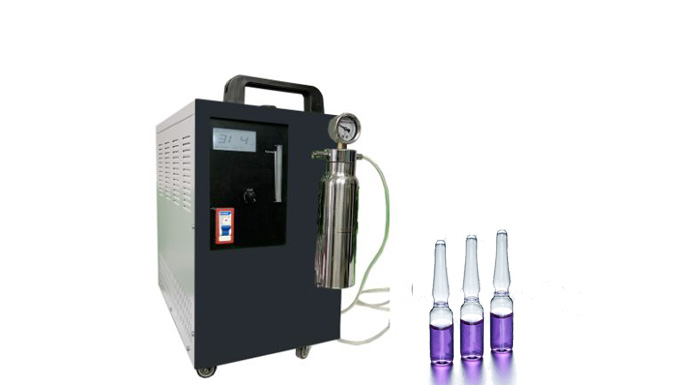
Oxyhydrogen generators use an electrolysis process that produces hydrogen and oxygen, instead of using a pre-filled fuel-gas cylinder. Jewelry equipment suppliers state this is just an on-demand gas-generation approach.
But cylinder requirements, ventilation, flashback protection and other factors influencing safety in the workshop must always be considered as part of the complete system. Appropriate operating procedures and equipment safeguards should not be ignored by on-demand generation.
Oxyhydrogen can be viewed as:
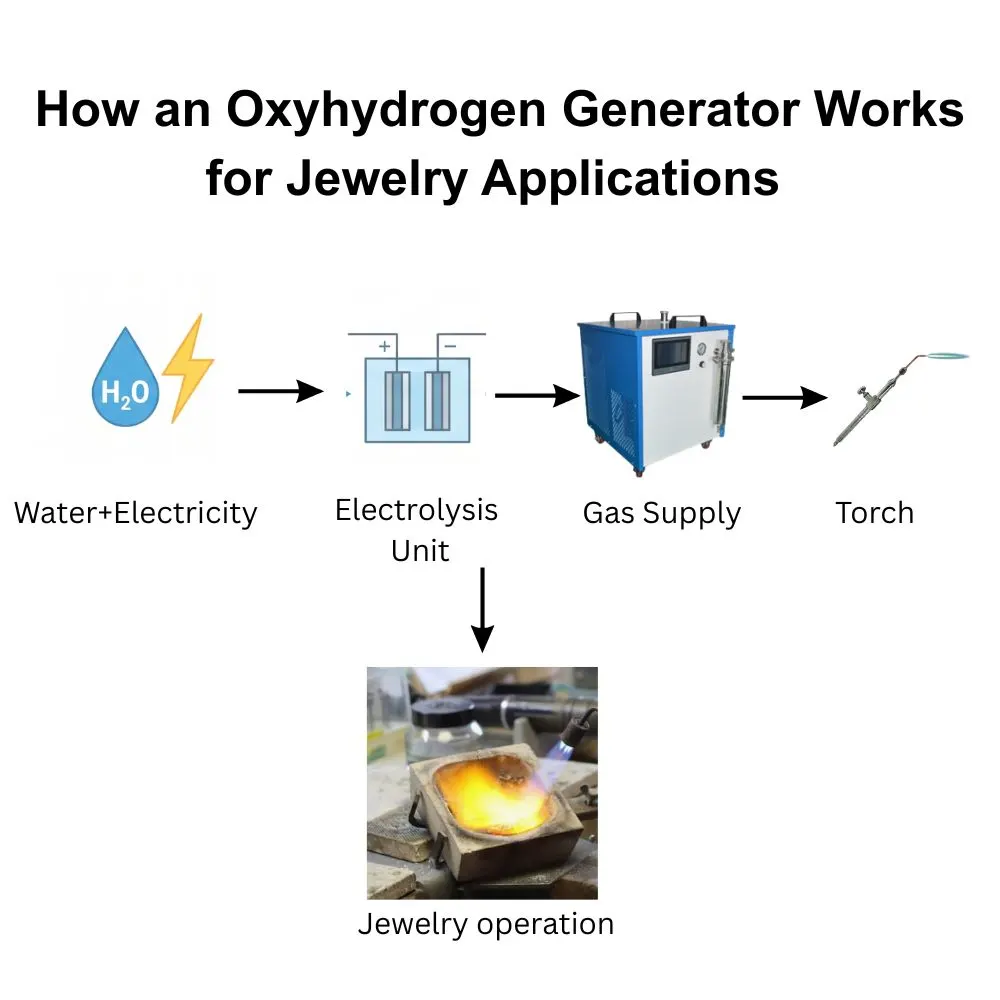
Water is split into hydrogen and oxygen by electrolysis which are then used for controlled flame, which in turn is used for jewellery application.
Hydrogen and oxygen can be separated from water by electrolysis. Gas is supplied to a torch to be fired and burned to heat. The output of the gas and different torch tips can be selected by the operator to get a proper flame for the workpieces, depending on the equipment.
Prep – Flame adjustment – Localised heating – Joining – Inspection
Jewelery parts are cleaned and ordered prior to the operator choosing the correct flame. In the welding of jewelry by the oxyhydrogen process, heat is focused on the area of interest until the base material in the area to be welded and, if used, the joining material reach the conditions necessary for welding. The finished joint is then inspected and finished.
Inspection – Preparation –Localized Heating – Repair – Finishing
It is important to identify the failure mode mechanism before you start the repair. Then, the operator cleans the damaged portion, chooses the suitable flame and is performing the job while limiting the amount of heat reaching the nearby parts.
This can range from jewelry repair welding and jewelry repair soldering to the repair of rings, chains, clasps, prong jewelry and jewelry resizing.
Metal Preparation: → Crucible → Heating: → Melting: → Casting/Remelting:
The metal charge is made up and transferred to a suitable crucible for melting. Whereafter, the flame is also channeled to the charge, and the melting process is observed. Collisions of small items should be considered as different requirements from a heat transfer point of view, while filling a metal batch for melting requires much different heat transfer as compared to joining a small item of valuable metals with oxyhydrogen.
The oxyhydrogen generators can be used for production joining and assembly applications involving a controlled flame that can be used in jewelry manufacture. Fine component joining, small production operations such as assembling chains and rings, and assemblding earrings might be some examples of applications.
Flame temperature is not the only production value to consider for a production workshop. Repeatability, nozzle selection, gas output, operator access and the number of workstations are more critical in designing a production process.
For repair workshops, flexibility is often required as each repair requires a different geometry. Various flame(s) and heat input amounts are possible for gold jewelry repair, silver repair, platinum repair, ring repair, chain repair and clasp repair.
A controlled and correctly set-up oxyhydrogen can be used to meet the demands of localized heat for certain of the repair tasks, while the operator can control the flame to make it fit the part.
Oxyhydrogen technology can be used for selected casting-defect repairs, annealing and other local heating applications in casting and finishing workshops. There are also some commercial systems that provide a service of small-scale melting and recycling.
Custom jewelry makers often produce a few pieces, and their creations are quite a bit more complex and depend on oddly shaped fitting with various geometries. As long as there is a controllable flame to support jewelry assembly, component join, solder and repair, there is no need for additional heat sources to complete each small task.
Depending on the suitable operations of recycling companies with scrap-to-be melted or unmelted, oxyhydrogen equipment might be considered. The overriding factor is capacity. Not all systems designed for small beads and jewellery joining can be expected to make good output for high volumes of recyclates.
Here the ideal choice of the oxyhydrogen generator must be applied instead of just the easiest name of the highest maximum flame temperature.
Find whether a metal is gold or silver or one of the alloys and whether the metal is one of the group elements or not. The composition of the material influences the melting characteristics, requirements for heat transfer and the needs for joining.
Determine the primary demand of the workshop: Fusion welding, oxyhydrogen jewellery soldering, brazing, annealing, Localized repairing and melting. The processes call for greatly different shapes and intensities of the working flame.
It can apply to any fine chain but should not be adhered to for a large bracelet part. Generally small parts will require a smaller, controlled flame, whereas larger workpieces will require more heat output.
The selection of the nozzle will have a direct influence on the flame that is supplied to the workpiece. There are several tips available for use in jewelry systems, for both precision and larger heating applications.
The equipment types of a workshop for subjective repairs are different from a manufacturing plant with several workstations that are in operation for most of the day.
If the application is to melt, figure out how much metal there should be melted per batch. One of the main specifications for deciding on the suitability of a torch-based system is this.
Is the gas generation needed on demand, are existing fuel-gas systems required, or an agg. of technologies such as heating.
As the electrolysis system in oxyhydrogen generators can only be powered by electricity, electrical power is needed to run them. Therefore, existing conditions of voltage, phase, power consumption and available electrical requirements should be determined prior to the equipment selection.
That doesn’t mean an oxyhydrogen system has to be used in place of all the torches and furnaces now in use. Use it more effectively for those operations where its controllability/effect of the flame is most useful.
Ventilating, gas collecting systems, gas ignition and flashback prevention, electrical considerations and proper use of PPE and manufacturer operating procedures should be considered in jewelry workshops. Equipment to be installed and operated in accordance with manufacturer’s guidelines and local needs.
This is especially true for the comparison of cutting equipment for oxyhydrogen flame soldering, welding and melting. The higher the flame, the better the result is NOT necessarily. The valuable question becomes, can the system provide sufficient heat, in the right location, for the desired time?
Oxyhydrogen flame jewelry welding is a process that applies a localized heat source, a hydrogen and oxygen flame created by electrolysis to the and welder the components of appropriate jewelry. For gold, silver and platinum jewelry welding, commercial systems are used.
Selected applications for use in Welding, Soldering, Brazing, Annealing, repair and Melting. The necessary set up will vary depending on the material, the component’s size, and the rate of heat input and production method.
Yes, the use of appropriate systems can be achieved with performing gold joining applications. Based on the material, the flame size, heat input and joining technique should each be suitable to the gold alloy and component to perform welding of gold jewelry.
Yes. For processors in the jewelry industry where silver and platinum are used, oxyhydrogen generators have been employed. Heat and contamination management are important considerations when working with platinum and the joining flames used for hydrogen/oxygen differ.The management of heat and contamination is an important consideration when working with platinum pieces, and the flames used to join platinum were specifically referenced for hydrogen/oxygen.
Commonly there is fusion at the join in welding, but a soldering process is using a filler metal that will melt at a lower temperature than the soldered parts. Two processes need thus two different techniques and heat-input strategies.
Yes. For certain applications of ring, chain, clasp and fine-component repair, oxyhydrogen systems are applied. A good example of this is around a small repair area where the heat is needed to be concentrated.
Yes, some casting repairs can be made on a local scale with the right systems. There are commercial oxyhydrogen equipment available that are sold to close small casting flaws and to fill small holes.
It can be applied in selected gold and silver melting applications where the generator and torch and crucible are able to supply adequate heat input for the required charge size. It is not appropriate to use the label high volume melting equipment for a small precision system.
Yes, there are some jewelry oxyhydrogen applicators for silver scrap melting & recycling. The right system is determined based on the amount and frequency of the heat melting of scrap required.
In traditional systems, the use of existing gas supplies or the production of fuel gases from existing gas sources is used, while oxyhydrogen produces the fuel gases, hydrogen and oxygen, as required. The choice of technology should be based on where the technology performs its functions, its flame-controlling capabilities, facility required, the demands of the operation and safety.
The jewellery making activity requires much more than making a hot flame. The heat source should be suitable for the material, the geometry of the component, their joining process and the desired amount of control. The “oxyhydrogen” technology presents another path that produces hydrogen and oxygen by splitting water together and provides pure hydrogen flame to burn under a controlled flame torch.
The most important areas for use of oxyhydrogen flame jewelry welding are small part joining, manufacturing assembly and specific repair. Another application category is oxyhydrogen jewelery soldering, which is used to produce a controlled joint between two compatible materials without unnecessary melting of the jewelry’s components itself.
For some selected workshops, oxyhydrogen jewelry melting can be expanded in the field of precious-metal remelting and in the recycling of precious metal scraps with the given output of the generator as well as torch, provided the batch size is in the range where it can be processed. The same technology can be used for other localized heating jobs such as repair work for casting and annealing.
In the end, oxyhydrogen flame for jewelery should be considered as the heat source for a particular application. Gold S, Silver S and Platinum S and their alloys have various processing requirements, and different heat input for welding, soldering, repair and melting.
The most helpful question for any jeweler’s business is thus not just “How hot is the flame?” but “Can this oxyhydrogen configuration provide the required amount of heat at the required location in order to achieve the desired process?” This will give a better foundation to choose equipment for jewelry and jewellery making, repair, joining and precious metals.