The production of jewelry today requires it to be very precise and consistent as well as aesthetically flawless. Be it in designing a fine chain of gold or creating a complex set of gems, the quality of joints is a decisive factor in the determination of the ultimate product durability and looks. This is where the best jewelry welding machine is required to be chosen.
New sophisticated tools have revolutionized the working processes of a jeweler as they are able to get finishes cleaner, stronger bonding and higher productivity. An assuring welding machine that is used in jewelry can improve craftmanship, minimize wastage of materials, and minimize rework. In the quest to become scaled and efficient, making an investment in the best welding machine for jewelry is no longer a choice but a strategic one.
Jewelry manufacturing equipment has developed and modified its ways of production equipment to modern welding equipment that has greater levels of control and precision. Effective knowledge in the modalities of how to weld gold jewelry needs the correct equipment as well as the knowledge in the current method of welding and selection of machines stands as one of the major points of continuity in the attainment of uniform outcomes.
The technology of jewelry welding has been greatly developed and a variety of choices are available depending on varying requirements of production. The most common ones are laser welding, hydrogen (oxyhydrogen) welding, pulse arc welding and conventional torch-based systems.
The world has diversified in the need to have advanced equipments and the need to have such equipment has brought the suppliers like the china jewelry tools and equipment manufacturer companies that have propelled innovation and affordability. These manufacturers are promoting the prevalence of the latest welding solutions, and high-quality tools are available to the representatives of small workshops and large production organizations as well.
The transition to making based on precision has motivated the jewelers to abandon the manual process and embrace the automated one. The appropriate welding machine to be used to do some jewelry depends on several factors that include the extent of its production, material to be used and the precision needed. With advancement in the industry, the goal of obtaining the best jewelry welding machine does not come easy, considering the trade-offs between automation, price and performance.
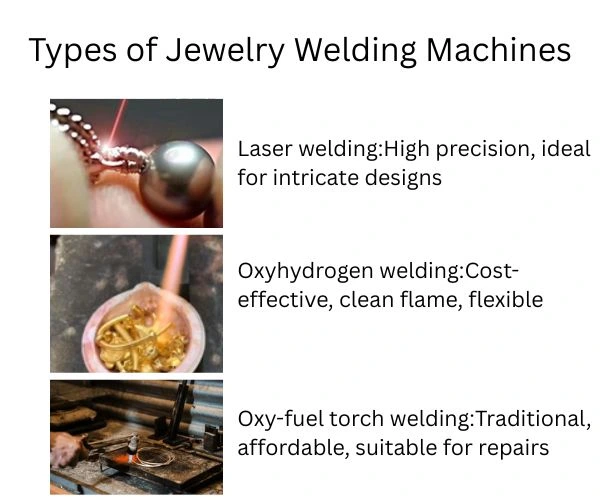
Laser welding for jewelry is one of the most modern and highly used in jewelry making in high end production. Laser welding jewelry permits the extremely precise heat application and it is therefore ideal in delicate designs and other intricate detailing.
A jewelry laser welding machine has various benefits such as being heat localized where there are low levels of heat-affected zones, less oxidation and high precision. This has made it ideal in application in the field of fine metals and gemstone settings where precision is very important. Precision welding for jewelry guarantees the capability to conduct small elements of the piece, particularly those that would have broken the other materials without any problems.
Laser welding has limited drawbacks despite its benefits. It would need not only more initial investment, but maintenance as well as trained operators to obtain best possible results. In the comparison of the two, laser vs hydrogen welding jewelry machines, one will find that laser systems are more commonly used in applications that require extreme accuracy, whereas other systems can be more economical.
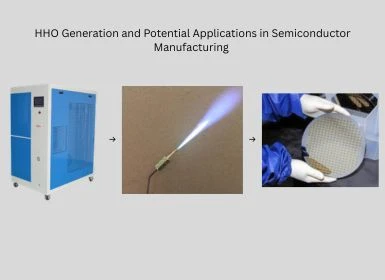
Oxyhydrogen welding or hydrogen welding is also becoming a popular entrant in the jewelry-making industry as an alternative method of manufacturing jewels at far cheaper costs in an environmentally friendly manner. Oxy hydrogen gas welding is the technology which utilizes the generation of hydrogen and oxygen by the electrolysis of water and afterwards combustion to create high-temperature and clean flame.
Hydrogen welding machine will work without utilizing gas cylinder, which is safer and convenient in the workshop. The heat, which is usually approximately 2800 o C, suits the use of precious metals an example of which includes gold and silver. A hydrogen welding torch offers maximum dexterity so that the jewelers can articulate the heat where dexterity is essential.
As a type of the oxyhydrogen water welding machine, modern systems like TX-HO600 Oxy-Hydrogen Jewelry Welding Machine and other hi-tech systems ensure the same performance in all the workstations. The mentioned oxyhydrogen flame brazing machine also helps to lower the benefits that the technology has brought such as a decrease in oxidation and the increase in the quality of that joint as well as the operating costs involved.
Comparing the laser vs hydrogen welding jewelry, the latter have the benefits of cheapness, user-friendliness, and the ability to perform clean cutting that makes them a great option in either small or mass production.
Conventional welding that has been practiced in making jewelry is also still relevant in some applications. An orthodox torch arrangement is usually a mixture of fuel gases like acetylene or propane mixed and mixed up with oxygen to form a flame to be used in soldering or welding.
Such is the case with systems such as oxy-acetylene welding equipment and oxygen and acetylene welding which have been in use over the decades because of their affordability and ease. Moreover, propane gas welding is the other option, which provides a fuel that can be used in smaller shops.
Nevertheless, the approaches have drawbacks. They are more prone to generate levels of oxidation, they take a lot of handwork, and they are less precise when compared to contemporary welding technologies. Despite these disadvantages, the traditional torch systems are still involved in the jewelry manufacturing equipment especially in repair works, and small volume productions.
To choose an appropriate method in the process of producing jewelry, it is necessary to understand the difference between welding and soldering methods. The process, temperature, and the results of soldering vs welding jewelry are different.
Filler metal with lower melting temperature is used in soldering to glue together components and welding is performed by direct fusing of the base materials. The consequence of this is tougher and more robust joints in the event of welding. To those who are learning how to weld gold jewelry, it is important to learn how to control the heat and also handle the material.
Welding gold jewelry is a process that is becoming popular in the contemporary production processes because of its robustness and polished appearance. The selection of best welding method for jewelry is dependent on design complexity, material to be used and production need.
The performance and cost are some of the most important factors to consider when choosing a jewelry welding machine. Small workshops are fitted with entry-level machines whereas the industrial systems are meant to deal with high volume production.
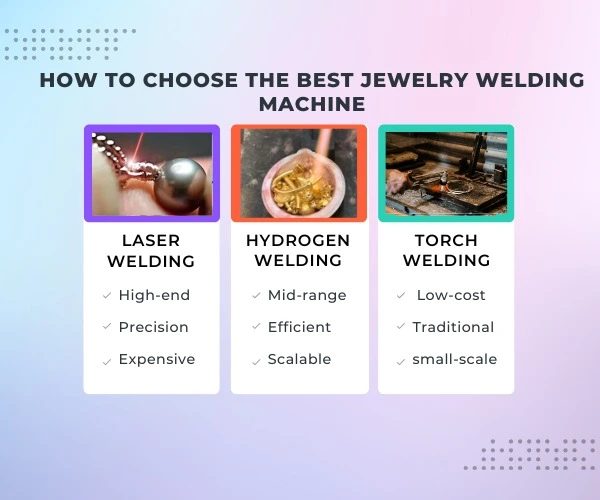
Systems that use hydrogen provide a compromise environment on both cost and performance. Hydrogen welding machine is the one that is most likely to be placed in the middle range category because of the high return on investment that it offers, in terms of reduced operation costs and better efficiencies. Alternatively, laser systems are the high-end segment of the market, which provides impeccable accuracy and demands a more expensive price.
Pulse welders and conventional systems offer cheaper alternatives to the particular applications, but they could be less versatile compared to current technologies. The type of material to use, the size of production, and the accuracy should be considered when selecting a jewelry welding machine.
And in the end the best jewelry welding machine would be based on your individual requirements. Laser systems are perfect in precision work which is of high-end. Hydrogen welding solutions are very desirable to use when production is required to be cost-effective and scalable. Being a part of the modern jewelry manufacturing equipment, they are creating the future of the Jewelry production, particularly when one is comparing the laser vs hydrogen welding jewelry in the different applications.