The metal fabrication industry is always evolving, with the goal of manufacturers being to produce cleaner, safer, and with better efficiency. The rising energy expenses, tougher environmental laws, and growing demand for accurate production have pushed companies to look for options to normal fuel gases. The modern flame cutting technologies are of a vital importance for steel fabrication, ship building, heavy equipment manufacturing and construction industries, where high speed flame cutting is required.
One of the most talked about technologies in discussion today is the oxyhydrogen vs oxy acetylene cutting systems. Although oxy-acetylene has been used for years as the industry standard, hydrogen is a fuel being considered by many businesses for industrial flame cutting due to its efficiency of operation, cleaner combustion and simplified gas handling.
The oxy acetylene cutting flame process has been in use for a long time with carbon steel or other ferrous materials. It is a process that brings oxygen into contact with acetylene gas to produce a high-temperature flame that can heat metal to its ignition temperature and then the oxygen stream removes the molten metal.
This technique is still routinely employed in fabrication shops, repair shops, structures and manufacturing or heavy industry processes that demand reliable flame cutting. While acetylene systems may be found to be successful and versatile for many industrial flame cutting applications, they do involve careful storage, transportation and handling of compressed gas cylinders and periodic safety checks.
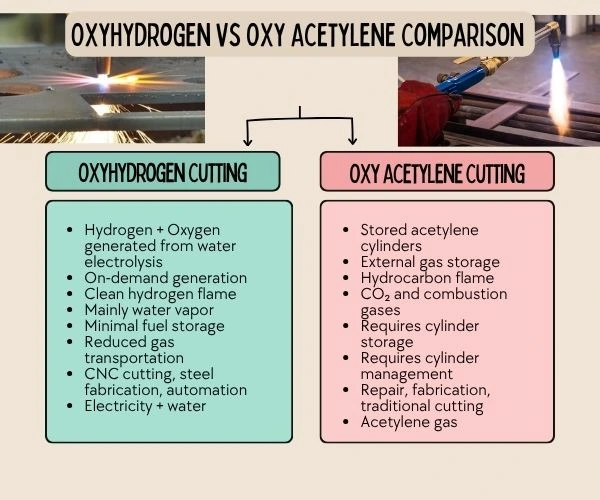
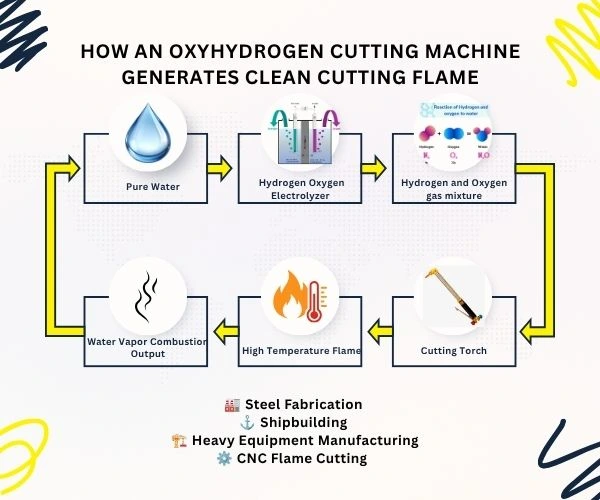
A modern alternative is known as oxyhydrogen flame cutting, which is based on the process of electrolysis and the generation of hydrogen and oxygen gases directly from water. An oxyhydrogen cutting machine generates gas as needed, providing a clean and uniform flame for cutting operations, eliminating the need for the storage of fuel cylinders.
The purified water is split by the electrolysis into hydrogen and oxygen gas that are directly supplied to the torch. This helps to save the reliance on external gas supply and also helps cleaner combustion. As the manufacturing process continues to modernize, hydrogen-powered flame cutting machine has been by now widely used in the process for ease of operating and the demand for being environmentally friendly.
Oxy hydrogen is different from oxy acetylene, by using fuel as its source. The oxy-acetylene systems rely on stored cylinders of acetylene gas and the oxy-hydrogen systems produce hydrogen and oxygen gases on site by electrolysing water.
The two pieces of technology also vary in their flame properties, heat distribution, storage needs and environmental effects. An oxyhydrogen flame cutting system will not require acetylene cylinders to be transported and combustion by-products are minimized in the process, while an oxy acetylene cutting flame still delivers very good cutting performance for many of the traditional industrial applications. These differences in operations can affect the production needs, safety policy and operating cost for the long run of purchase decisions.
One of the most significant factors to consider when choosing a cutting technology is performance. Both systems will work for heavy-duty industrial flame cutting applications, but the efficiency will vary according to thickness, production volume and application needs.
In modern flame cutting machines, the use of hydrogen technology can ensure the stability of the flame, which can help to obtain clean cutting edges with minimal amount of slag. Other factors that need to be taken into account when comparing oxyhydrogen vs oxy acetylene include cutting speed, heat affected zones (HAZ), dimensional accuracy, and repeatability in high volume fabrication environments.
Operating costs can vary from one year to the next and may be more than just fuel. Maintenance of acetylene tanks, transport, storage and periodic safety tests are all necessary with the traditional acetylene system. These recurring costs can add up over time and contribute to the total cost of ownership.
This oxyhydrogen cutting machine produces gas as it is required, eliminating the need for external gas supplies, making day to day use easy. In certain manufacturing processes that are using more advanced industrial flame cutting solutions, many are also taking advantage of advanced flame cutting machines that use on-demand hydrogen generation technology as this technology requires less maintenance, especially in facilities with continuous productions.
The prospects of integrating hydrogen systems with CNC flame cutting machine technology are growing more and more appealing in the context of the ongoing transformation in modern manufacturing. In automated cutting environments, it is important to use the same flame to achieve the same cutting quality for long production runs.
Oxyhydrogen flame cutting technology is applied in the CNC system, which not only has the characteristics of high precision but also can be used in the production of structural steel, shipbuilding, heavy engineering, pressure vessel, industrial equipment and other industries. With the growing automation of industrial flame cutting operations, hydrogen-based technologies are receiving an increasing amount of interest because of the consistent performance and operation of such processes.
PTXSON designs and builds state-of-the-art hydrogen generation systems, which can be used in modern flame cutting processes to ensure reliable gas production on-demand. The company’s Hydrogen Oxygen Electrolyzer HHO Hydrogen Generator adopts electrolysis technology to produce hydrogen and oxygen directly from water, avoiding the need for traditional storage of fuel gas, and achieving efficient cutting performance.
PTXSON’s Oxy Hydrogen Generator is designed to be used in the manual and automated oxyhydrogen cutting machine applications in fabrication workshops, steel processing plants, industrial manufacturing plants. These systems are designed to supply an oxyhydrogen flame cutting system that is stable and compatible with a variety of flame cutting machines, including CNC cutting systems. They also combust clean which helps to reduce gas handling needs and improve operational efficiency.
Environmental sustainability is becoming one of the considerations in manufacturing. Oxyhydrogen flame cutting results in a cleaner combustion process than hydrocarbon fuel gases and water vapor is the major combustion by-product.
Businesses that are considering oxyhydrogen vs oxy acetylene may see other operational benefits besides enhanced performance, such as no need to store acetylene and the lower transportation needs. Cleaner combustion can enhance the workplace environment and help the industrial flame cutting industry towards a more sustainable future.
The choice of oxyhydrogen vs oxy acetylene will vary based on production objectives, facility considerations, material characteristics, and operational considerations. Many traditional fabrication areas have infrastructure to use for oxy-acetylene, and this is still a viable option.
For those companies looking for on-demand gas generation, easier fuel handling and cleaner combustion, however, an oxyhydrogen cutting machine may provide some great benefits. Considering the production volume, automation levels, operating costs, environmental goals, and future manufacturing expansion is important when deciding which is the most suitable flame cutting solution to implement when evaluating an oxy acetylene cutting flame system with modern hydrogen cutting flame systems.